About Cyclura nubila (Gray, 1831)
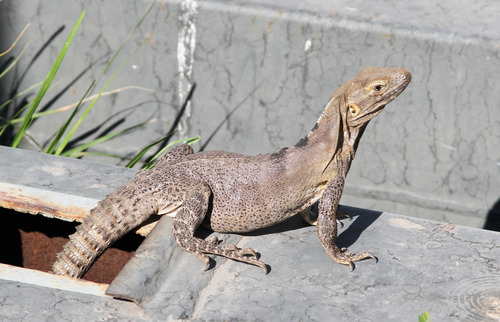
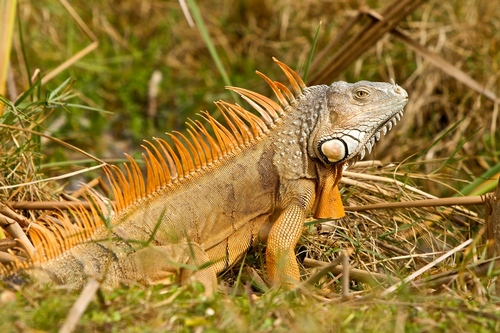
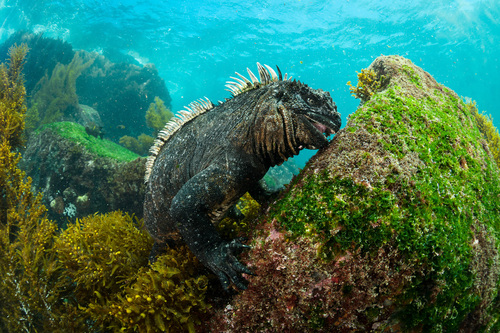
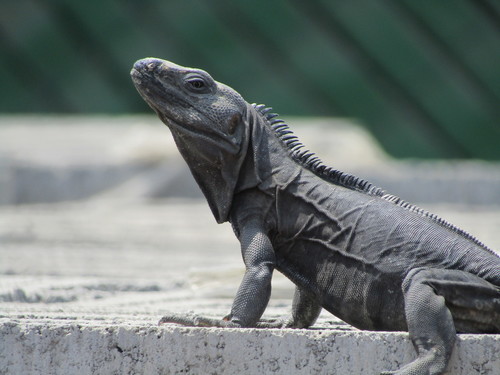
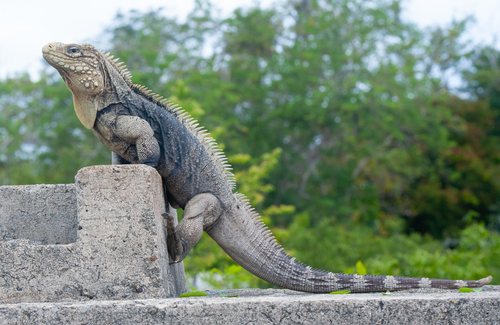
Cyclura nubila, commonly known as the Cuban iguana, is a large lizard species in the Cyclura genus. Only the blue iguana grows larger than the Cuban iguana within this genus. The Cuban iguana has an average snout-to-vent (base of the tail) body length of 40 centimeters (16 in). Rarely, very large males reaching 1.6 meters (5.2 ft) from snout to tail tip have been recorded at the wildlife sanctuary within the Guantanamo Bay Naval Base; females typically reach two thirds of that total length. This species is sexually dimorphic: males are much larger than females, and have enlarged femoral pores on their thighs, which they use to release pheromones to attract mates and mark territory. Male Cuban iguanas have skin color ranging from dark gray to brick red, while females have olive green skin marked with dark stripes or bands. In both sexes, the limbs are black with pale brown oval spots, and the feet are solid black. Young Cuban iguanas are typically dark brown or green, with faint darker striping or mottling that forms five to ten diagonal transverse bands across the body. These bands blend into the overall body color as the iguana ages. Both sexes have a dewlap (loose skin hanging below the neck) and a row of spines that runs down their back to their thick tail. They have short, stout heads and necks, solid broad teeth, and powerful jaw muscles. Their jowls grow larger as the animal ages, and are covered in spiky protuberances called tubercles.
The Cuban iguana is native to rocky coastal areas of Cuba, and lives across as many as 4,000 islets surrounding the Cuban mainland, including Isla de la Juventud off Cuba's southern coast, which hosts one of the species' most robust populations. Populations occur on islets along Cuba's north and south coasts, and in protected areas on the Cuban mainland. These protected areas include the Guanahacabibes Biosphere Reserve in western Cuba, as well as Desembarco del Granma National Park, Hatibonico Wildlife Refuge, Punta Negra-Quemados Ecological Reserve, and Delta del Cauto Wildlife Refuge, all located in eastern Cuba. The population at the US Naval Base at Guantánamo Bay is estimated at 2,000 to 3,000 individuals, and the animals are well-treated and protected by US forces stationed at the base. According to Allison Alberts, an ecologist at the San Diego Zoo, among the many wildlife species at the base, "the Cuban iguana is one of the largest, undoubtedly the most visible, and certainly the most charismatic. It seems that no one completes a tour of duty at GTMO without getting to know these prehistoric-looking giants". An unusual incident took place in 2005, when a detainee at the base's prison assaulted a guard using a bloody tail torn from a Cuban iguana.
One subspecies, C. n. caymanensis, is endemic to the Sister Islands of Little Cayman and Cayman Brac. Fewer than 50 individuals of this subspecies remain on Cayman Brac, while Little Cayman supports a population of 1,500. A feral population of C. n. caymanensis has also become established on Grand Cayman.
Cuban iguanas dig their burrows near cacti or thistles, and sometimes even burrow directly within cacti. These thorny plants provide protection for the iguanas, and the plants' fruit and flowers serve as a food source. In areas without cacti, the lizards dig their burrows in dead trees, hollow logs, and limestone crevices.
In the mid-1960s, a small group of Cuban iguanas was released from a zoo on Isla Magueyes, southwest of Puerto Rico, forming an independent free-ranging feral population. As of 2000, the US Department of Interior had discussed removing or relocating this feral population. This feral population is the source of 90% of all captive Cuban iguanas held in private collections. A 1998 study compared the head-bob territorial displays of the native Cuban population to the feral Isla Magueyes population. The duration of displays and the pauses between displays were up to 350% longer in the feral population. For comparison, head-bob displays of the Grand Cayman blue iguana differed from those of native Cuban iguanas by only about 20%. The rapid change in display structure between the Isla Magueyes colony and native Cuban iguanas illustrates how a small founding population size can act as a catalyst for evolutionary change in communication or display behavior. In this case, the change developed over at most six generations.
In the feral Puerto Rican population of Cuban iguanas, ants prey on iguana eggs.