About Cyclura cornuta (Bonnaterre, 1789)
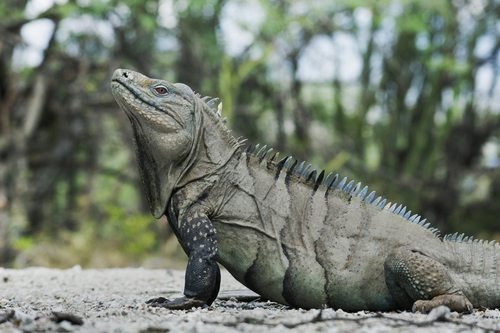
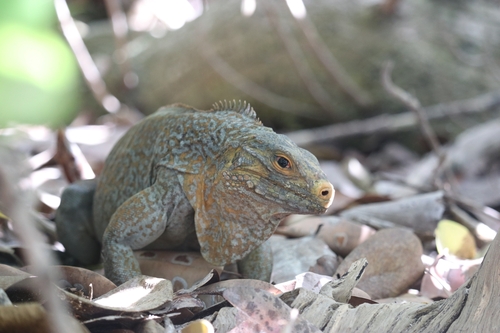
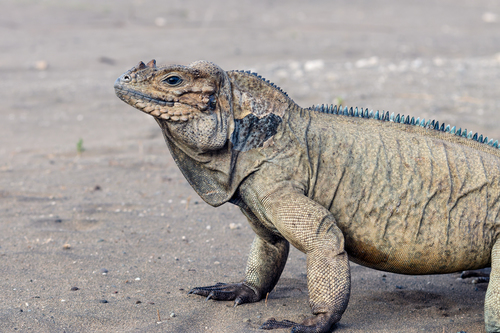
Anatomy and morphology: Like other members of the genus Cyclura, the rhinoceros iguana (Cyclura cornuta) is a large-bodied, heavy-headed lizard with strong legs and a vertically flattened tail. A crest of pointed horned scales runs from the nape of its neck to the tip of its tail. Its color is uniform dull gray to brown. Most adult individuals weigh between 4.56 and 9 kilograms (10.1 to 19.8 lb). Like all reptiles, rhinoceros iguanas are cold-blooded, meaning they rely on external heat sources to regulate body temperature, and they move with the shifting sun to maintain an optimal internal temperature. This species is defined by prominent bony tubercle growths on its snout that resemble horns. Males have a helmet-shaped adipose pad on the occipital region of the head, as well as a large dewlap. Like other Cyclura species, the rhinoceros iguana is sexually dimorphic: males are larger than females, have more prominent dorsal crests and "horns", and have large femoral pores on their thighs used to release pheromones.
Distribution and habitat: Rhinoceros iguanas are found across scattered locations throughout Hispaniola (covering both Haiti and the Dominican Republic). Stable populations only exist on Isla Beata and the far end of the Barahona Peninsula within Jaragua National Park. Moderately dense populations are found in southeastern Haiti and its offshore islands, including the brackish Étang Saumâtre, as well as the Dominican Republic's hypersaline Lake Enriquillo and its lake island Isla Cabritos. Populations in Haiti are at greater risk of extinction due to deforestation, poaching for bushmeat, and land clearing by humans. While not restricted to a single habitat type, rhinoceros iguanas are most abundant in the scrub woodlands of Hispaniolan dry forests, which feature xeric, rocky terrain of eroded limestone with sparse vegetation. They also live in coastal terraces, mainland lowlands, and multiple offshore islands and small cays, all with slightly different habitat characteristics. The rhinoceros iguana prefers biomes that receive very little rainfall and have few trees or shrubs. True to the "rock iguana" common name for the genus, the species favors fairly barren landscapes with large smooth boulders and rocky outcrops for basking, along with enough crevices and sheltered areas to retreat into. When threatened by predators including humans, birds of prey, and feral dogs and cats, they immediately flee into rock crevices to hide. Like other iguanas, this species shows phenotypic plasticity. While it historically lived near coastlines, human activity and introduced predators have forced rhinoceros iguanas to move inland. On May 4, 2008, an individual from Limbe Island in northern Haiti was photographed after being caught by fishermen from Bas-Limbe, Bord de Mer village. Rhinoceros iguanas caught on Limbe Island are illegally consumed by the local population, and this sighting confirmed a new range area that was previously not recorded for C. cornuta. Aside from Hispaniola and its surrounding islands, the rhinoceros iguana was once found on Navassa Island (hosting the endemic subspecies C. c. onchiopsis), but the species has been extirpated there.
Mating and reproduction: Unlike other Cyclura species, male rhinoceros iguanas reach sexual maturity at 4 to 5 years of age, while females reach sexual maturity at 2 to 3 years of age. Male rhinoceros iguanas are territorial, and the most aggressive males hold the largest territories. Mating occurs at the start of, or just before, the year's first rainy season (May to June) and lasts 2 to 3 weeks. Within 40 days after mating, females lay between 2 and 34 eggs, with an average clutch size of 17. Females guard their nests for several days after egg-laying, and incubation lasts approximately 85 days.
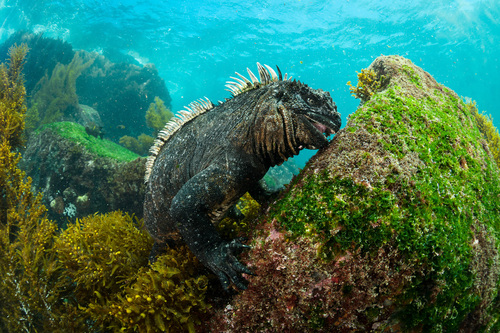
Notably, while rhinoceros iguanas do show some sexual dimorphism in size and horn development, they have considerably less sexual dimorphism than most other iguana species. Both male and female rhinoceros iguanas lack prominent mid-dorsal spines on the neck (which are typically very large in males of other iguana species), both have well-developed dewlaps, and both grow horns. By comparison, horns are often only present in males of many other horned animals such as ungulates and rhinoceros beetles. Rhinoceros iguanas are also reported to have less size dimorphism than other iguana species. This reduced dimorphism is suggested to stem from intense female-female competition in the species' island environment, where nesting sites are scarce. Females use their horns to fight one another for access to nesting sites, just as males fight for access to females. Similar female-female combat over nesting sites has been recorded in other island iguanas such as the marine iguana.