About Cyclosa oculata (Walckenaer, 1802)
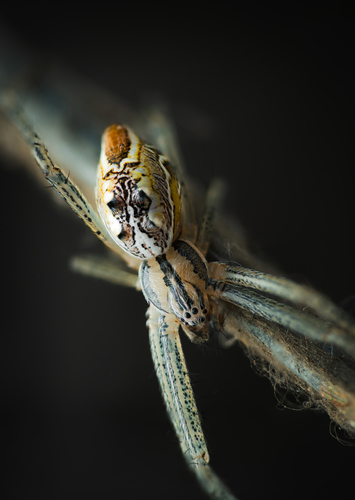
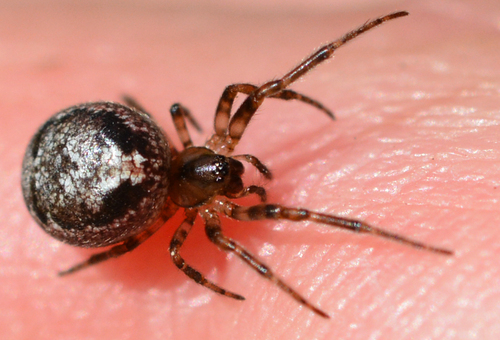
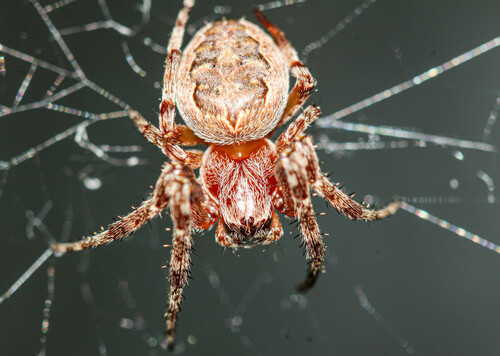
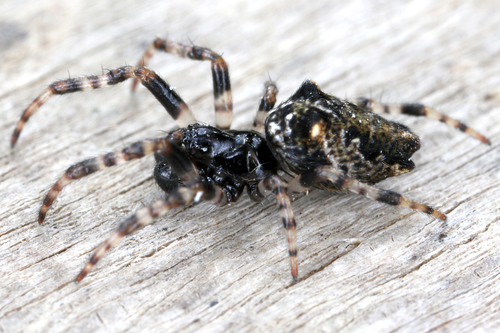
This species is scientifically known as Cyclosa oculata (Walckenaer, 1802). For adult males, the cephalothorax measures 2 mm in length, while the abdomen measures between 2 and 2.25 mm. For adult females, the cephalothorax measures 2 to 2.25 mm in length, and the abdomen measures 3.5 mm. The sternum ranges from dark brown to black, with three lighter, rounded reddish-brown spots on each side, plus a similar spot at its rear tip that appears to be formed from two fused spots. The legs display clear contrasting darker and lighter banding. C. oculata is widely distributed across Europe, extending east through Russia to the Far East, and south through the Caucasus, Kazakhstan, and Central Asia to China. It has been introduced to South Africa and Hawaii. Within Europe, the species has been recorded in Belgium, France (including Corsica), Spain, Austria, Hungary, the Balkans, Romania, and southern Russia. It has also been found in the Antilles and Venezuela. Simon proposed that this species likely originates from the tropics, and was introduced to European fauna long ago. Cyclosa oculata prefers sunny uncultivated wasteland areas that are neither mowed nor grazed. It occurs particularly on sparse sandy soils with late-growing plants, and can sometimes be found in large numbers in these habitats. It is absent from completely fallow scrubland areas, and favors warm locations. In mountainous regions, the species is not found at elevations above 600 meters. The web is constructed 20–25 cm above ground level on free-standing heath plants, broom, or similar vegetation. It is a typical web for the Cyclosa genus, but differs from the closely related Cyclosa conica in having fewer radial threads, which results in a slightly larger mesh size. Compared to other Cyclosa species, its sticky catching area has more of a radial extension. Matching the reduced number of radial threads, the web also has fewer attachment points. Older individuals build webs with a greater number of catching threads. The upper frame threads of the web are frequently strengthened through repeated use. In adult female webs, sticky threads are spaced 3–4 mm apart, with spacing becoming closer toward both the outer and inner edges. The catching area measures 90–100 mm across. Unlike the regularly shaped webs of other Cyclosa species, the web of C. oculata usually has a more extended radial shape. When at rest on the web, the spider holds its legs tightly drawn close to its body, faces head downward, and retreats to a hiding place when disturbed. The egg sacs are enclosed in cocoons that are integrated into the upper stabilimentum of the web. Each cocoon is formed from an oval, parchment-like plate that is 5 mm long and 2.5 mm wide. A mass of 14 to 26 agglutinated, ochre-colored eggs is laid onto this plate. The egg mass is surrounded by a brown fleece, and externally closed off by a gray roof-like covering that matches the appearance of the base plate. These brown, elongated egg structures are woven lengthwise into the upper stabilimentum. They often overlap like tiles, sometimes form a rosette arrangement, and may also occur in groups of 2–5 attached to the stabilimentum from different sides. The first juveniles emerge at the end of July, and mature individuals of both sexes can be found from the end of June to early July.