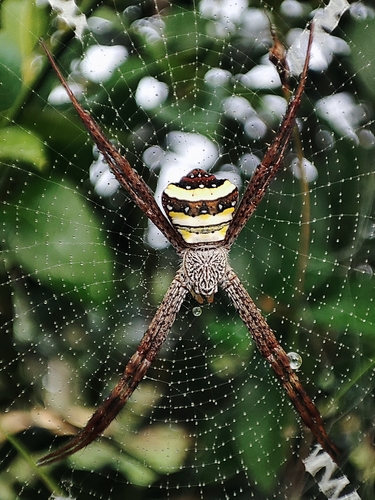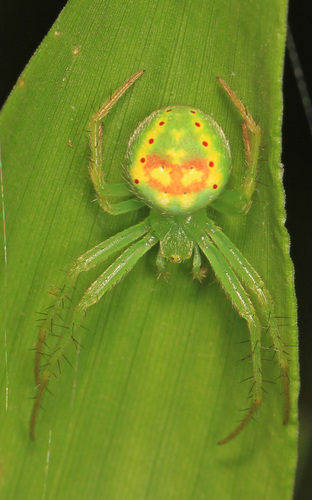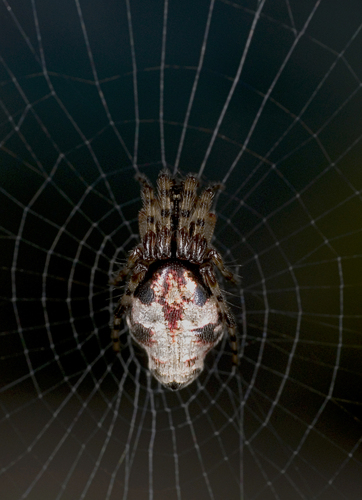
About Cyclosa argenteoalba Bösenberg & Strand, 1906
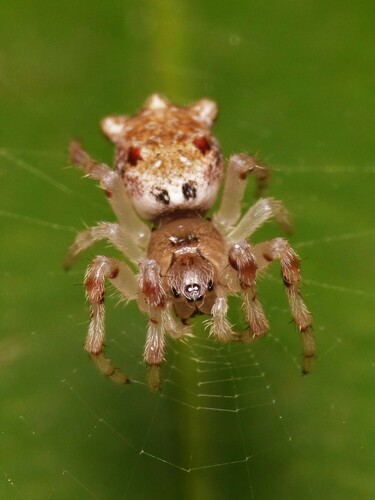
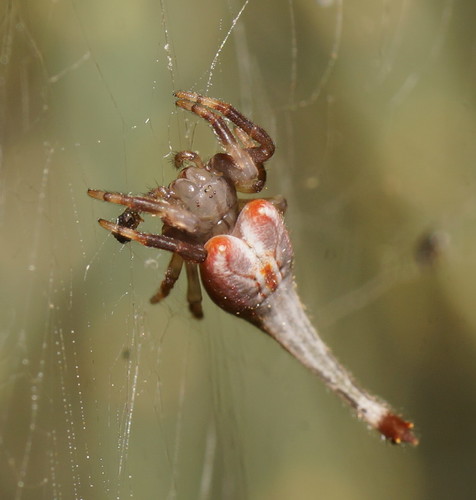
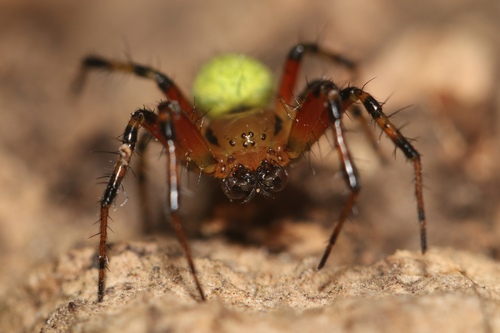
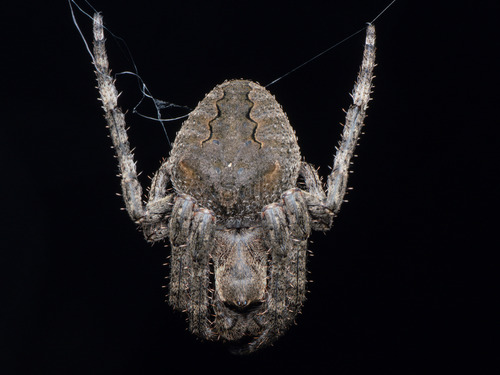
Cyclosa argenteoalba Bösenberg & Strand, 1906 is a species of trashline orbweaver that belongs to the spider family Araneidae. It is found across East Asia, specifically in China, Korea, Taiwan, Japan, and Russia. This spider species is diurnal, meaning it is active during the day. Individuals with less silver body coloring are more successful at catching prey, because the bright silver pigment alerts potential prey to the spider’s presence. C. argenteoalba catches prey by waiting at the center hub of its web until prey moves close enough to capture. On average, females of this species are 2 mm longer in body size than males. During mating, female genital mutilation is a common occurrence that increases the male spider’s reproductive fitness. C. argenteoalba often adds silk "decorations" to its webs, which are believed to deter predators. The species frequently relocates to build new webs until it finds a location with a sufficiently large prey population. Parasitic larvae are often found attached to C. argenteoalba, and these larvae can change and control the spider’s behavior. This spider lives in farmland, mountainous regions, and suburban areas, but it is most commonly found on the edges of bamboo and wood forests where sunlight is adequate. C. argenteoalba usually produces two generations per year, and occasionally produces three. Reproduction typically occurs in May and August, and sometimes in October; during these reproductive months, the spiders have their highest seasonal body mass. After females lay their eggs, their abdomens become noticeably smaller, a trait that makes this species easier to study for reproduction research. Females do not lay eggs in their own webs, and instead choose to lay egg sacs in the surrounding area. Spiderlings emerge from their egg sacs approximately one month after being laid. The species overwinters while mature, and mature individuals begin building new webs in March. Compared to two other closely related Cyclosa species — C. octotuberculata and C. seduculata — C. argenteoalba has a faster growth rate, lower overall survival rate, larger relative clutch size, and smaller individual eggs. These traits reflect a larger reproductive investment by C. argenteoalba, which counteracts the species’ lower survival rate. C. argenteoalba also shows a more prominent reduction in clutch size for the second annual egg-laying event compared to the first.