About Cyclopterus lumpus Linnaeus, 1758
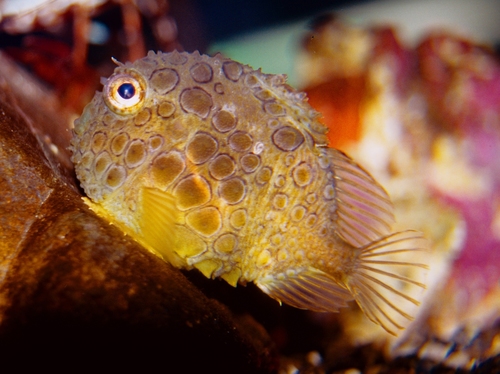
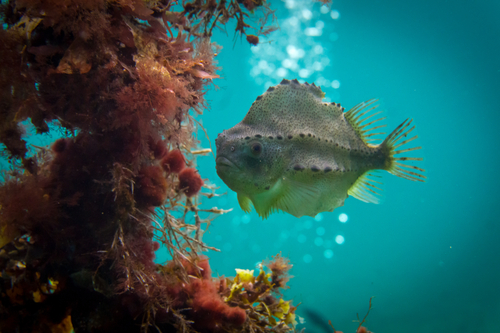
Cyclopterus lumpus displays sexual dimorphism, with females growing larger than males. Males typically reach 30 to 40 cm (12 to 16 in) in length, while females usually grow up to 50 cm (20 in) in length and 5 kg (11 lb 0 oz) in weight. The largest recorded specimen measured 61 cm (24 in) in length and 9.6 kg (21 lb 3 oz) in weight. In the brackish water of the Baltic Sea, this species usually does not grow larger than 20 cm (8 in). It has a ball-shaped body, a knobbly, ridged back, and three large bony tubercles on each flank. Its pelvic fins form suction discs that it uses to attach strongly to rocks or other surfaces. Males have larger heads and pectoral fins than females. There is a jelly-like layer of fat under the skin. Its colour is highly variable, and can be bluish, greyish, olive, yellowish or brownish. Mature males turn orange-reddish during the breeding season. The roe of Cyclopterus lumpus is a good source of omega-3 fatty acids, and is used to make relatively inexpensive caviar substitutes. After being removed from the fish, the roe is processed to remove connective tissue, then stored in large barrels and salted. It is dyed either red or black, and packed with a mould inhibitor such as sodium benzoate (E211). In Scandinavia, the flesh of this fish is eaten. In Iceland, males are often salted and smoked, or simply boiled. Female lumpfish are rarely eaten fresh, but when caught during the spawning season, their guts and heads are removed, the flesh is deeply scored with a knife, and they are hung in a cool place until the flesh turns yellow. The fish is then poached before serving as the Icelandic dish called sigin grásleppa. This species is also used as "cleaner fish" to lower parasite burdens on salmon farms in Scotland, Iceland and Norway.