About Cyclograpsus lavauxi H.Milne Edwards, 1853
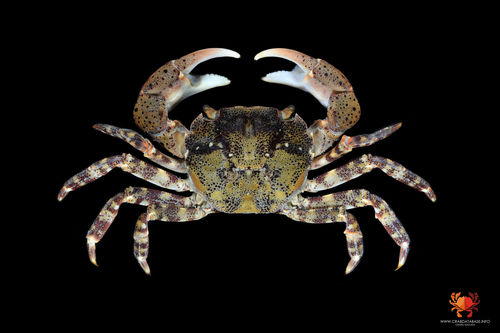
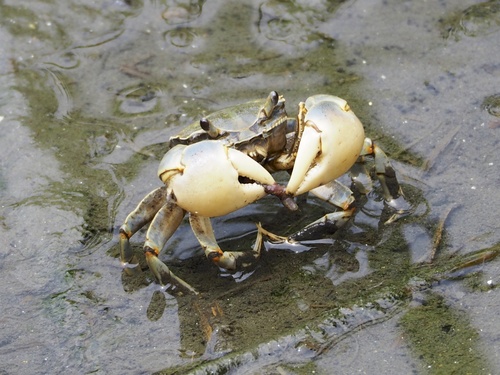
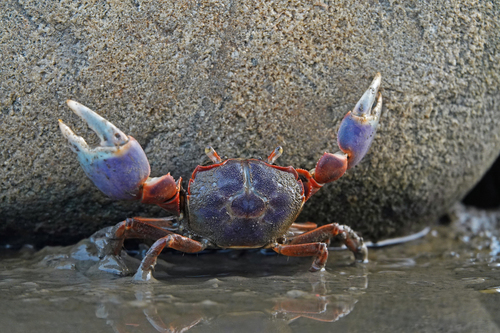
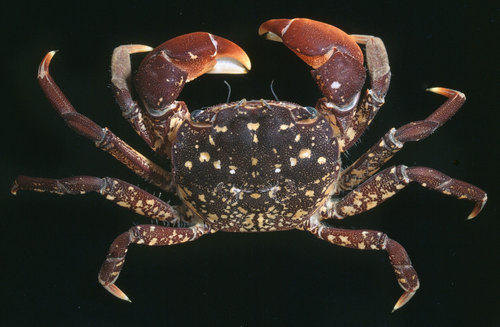
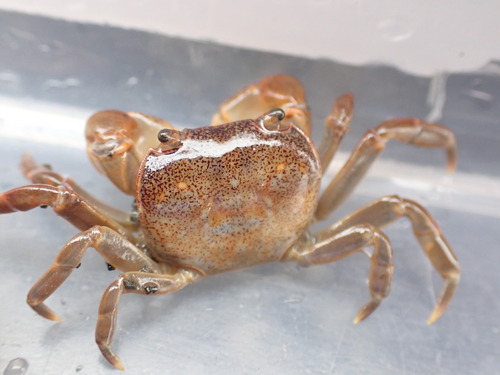
Cyclograpsus lavauxi is a small crab species from the temperate region, belonging to the Grapsidae family. Adult males average 28 mm in size, while adult females average 26 mm. Its hard outer shell, called the carapace, is polished and wider than it is long. On average, the carapace is 9 mm long and 11 mm wide. The edge of the C. lavauxi carapace is smooth. The front portion of the carapace has a straight edge, with two curved eye sockets located in the two front corners. Its antennae are well-developed, and are used to sense texture, food, and sound. C. lavauxi has eight walking legs and two large pincers at the front. Its legs are compressed, slender, and long; they have six lines of hair running the full 4 mm length of the legs, which are fairly robust. Small tufts of hair also grow between the first, second, and third legs. Its long legs allow it to run at rapid speeds, and C. lavauxi is agile and alert, making it a very mobile and versatile crab. Multiple different color variations (color morphs) have been observed in this species. The carapace can range in color from slate blue, bluish-grey, and fawn to yellowish-brown. It may also show several different shades of grey, green, and brown, often marked with dark brown and red speckles. The underside of the crab is a lighter, solid color than the carapace. The legs share the same base color as the carapace, with brighter speckled patterning. The natural distribution of C. lavauxi (also called the smooth shore crab) covers New Zealand and the Juan Fernández Islands of Chile. In New Zealand, it has been recorded at many sites from Hohoura Harbour to Westland, with large populations on the North Island. This crab can live in a wide range of coastal environments, including among boulders, under stones, and on beaches from exposed open shores to sheltered bays. It is a very common crab on New Zealand beaches, and occurs in larger numbers than the larger common rock crab species. It is found near the littoral (tidal) sea margin, in areas that are only rarely wetted by tides or not wetted at all. It has also been found on mudflats, in estuaries, and along rocky coastlines. Younger crabs prefer lower shore levels and mudflats, while older crabs prefer higher levels on the foreshore and mudflats. All C. lavauxi migrate to the lower foreshore line during the summer. The mating season for C. lavauxi falls during the summer months, from mid-October to late December. Mating is highly synchronous across the entire population. The species is not monogamous: both females and males mate multiple times in a single breeding season. Male-male competition for mates occurs frequently. Larger males will often attack other males that are mating with a female, which often gives the female an opportunity to escape. Likely as a result of this competition, mating pairs hide under rocks to avoid interference from other rival males. When mating, a male approaches a female and holds onto her carapace for one hour, followed by a two-hour copulation. Females often resist males and attempt to escape. Females carry developing eggs between November and February. They have a short receptive period that lasts fewer than 24 hours in the wild, or up to almost a week in captivity. Females lay their eggs in synchrony with other members of the population within a four-week window, and lay thousands of eggs in each clutch. Females that do not mate during a breeding season can still lay fertile eggs using sperm stored from the previous breeding season, which is kept in a specialized storage structure called the spermatheca after mating. Females only lay one clutch of eggs per breeding season. Newly laid eggs are dark purple, but lighten in color and develop black eyespots as they mature. The eggs measure 0.25 to 0.3 mm in diameter, and hatch after approximately two months. When newly hatched, the larvae measure just over 1 mm in length. C. lavauxi typically moults (sheds its exoskeleton) shortly after the breeding season ends, in late summer to early autumn.