About Cyclarhis gujanensis (Gmelin, 1789)
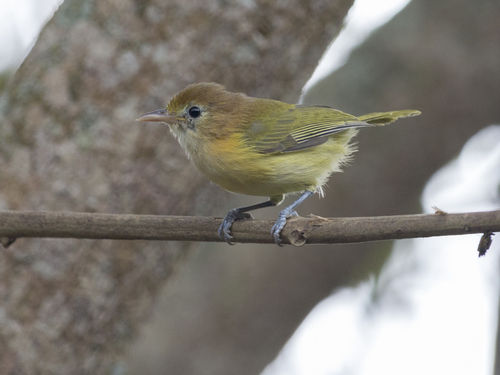
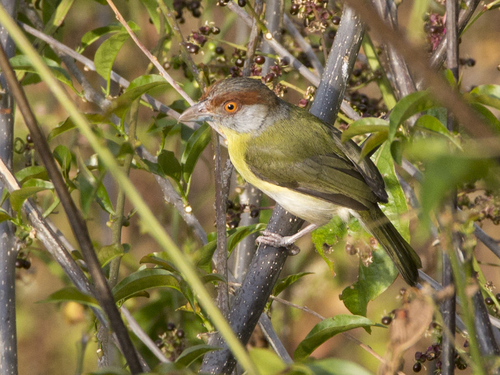
The adult rufous-browed peppershrike, Cyclarhis gujanensis, is approximately 15 cm (5.9 in) long and weighs 28 g (0.99 oz). It has a large head relative to its body and a thick, somewhat shrike-like bill: the lower part of the bill is typically blackish, while the upper part is pinkish-grey. Its head is grey with a prominent rufous eyebrow stripe, and the crown often has a brown tinge. The upperparts of the body are green; the throat and breast are yellow, which fades into a white belly. The subspecies ochrocephala, found in the southeastern portion of this bird’s range, has a shorter rufous eyebrow and a brown-tinged crown. Meanwhile, the subspecies virenticeps, contrerasi and saturata native to northwestern Peru and western Ecuador have greenish-yellow nape, ear coverts and cheeks, unlike the grey colouring seen in the typical subspecies. The rufous-browed peppershrike’s song is a whistled phrase that matches the rhythm of the phrase "Do you wash every week?", though the song varies widely between individual birds and across different geographic ranges. This bird is often heard but difficult to spot. It feeds on insects and spiders high in tree foliage, though it has also been observed preying on small lizards. For breeding, it builds a flimsy cup-shaped nest high in a tree. A typical clutch holds two or three pinkish-white eggs with light brown blotches. Like most vireos, the rufous-browed peppershrike ejects parasitic cowbird eggs from its nest.