About Cyclamen creticum (Dörfl.) Hildebr.
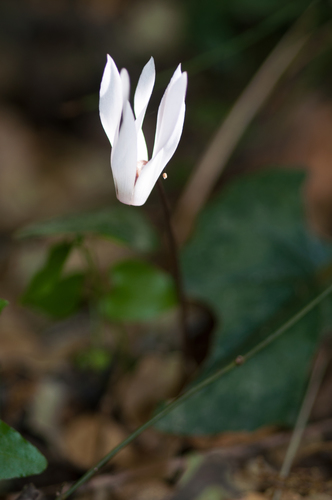
Cyclamen creticum (Dörfl.) Hildebr. is a small long-lived perennial herb with a tuberous rootstock, growing to around 15 cm (5.9 in) tall. This tender species typically grows in rocky areas, stream and river banks, gullies, or under bushes, and prefers shaded locations protected from direct sun. Its leaves are heart-shaped (cordate), often coarsely toothed, dark green with a red-purple underside, and bear cloudy or netted silvery markings on the upper surface. Within the species, there are two distinct forms of flower: Forma creticum and Forma pallide-roseum. Forma creticum has completely white flowers, and is the much more common of the two forms. Forma pallide-roseum has flowers ranging from white to light pink, with subtle pale pink coloring throughout. There is no clear separation between the ranges of these two forms in their native habitat. The flowers are hermaphroditic, solitary (not grouped into an inflorescence), strongly fragrant, and produce no nectar. The corolla is made up of five long, slender petals that lack auricles. Flowering occurs from April to May, and the flower stalk is long, thin, and red. Cyclamen creticum is endemic to the Greek Islands of Crete and Karpathos. It is abundant across Crete from sea level up to 1,300 m elevation, and is only known from two locations on Karpathos. Due to approach herkogamy, where the stigma sits above the anthers, Cyclamen creticum rarely self-fertilizes. Its insect pollinators include hoverflies and bumblebees.