About Cyathus olla (Batsch) Pers.
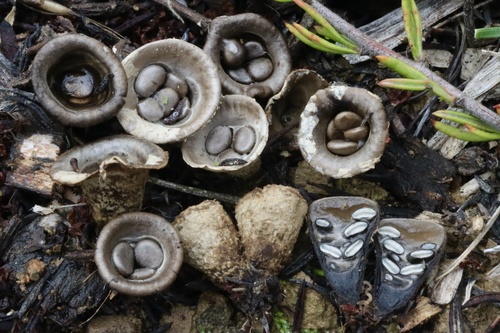
Cyathus olla (Batsch) Pers. is a fungus that gets its common name bird's nest fungus from its resemblance to a tiny bird's nest holding eggs. Its fruiting body, called the peridium, is roughly funnel-shaped, measuring 10–18 mm tall and 8–12 mm wide. The outer surface is greyish yellow, greyish brown, or fawn-colored, and covered with fine, evenly textured hairs. The inner surface is silver grey, smooth, and often marked with faint transverse ridges. The peridium is thick-walled, flares outward at the rim, and the rim typically has a wavy outline. The 'eggs', known as peridioles, number 8 to 10 per cup, are white or grey, 2–4 mm in diameter, and are noticeably larger than peridioles of other Cyathus species. Each peridiole is covered by a thin membrane called a tunica. Most peridioles attach to the fruiting body via a funiculus, a hyphal structure divided into three regions: a basal piece that attaches to the peridium's inner wall, a middle piece, and an upper sheath called the purse that connects to the lower surface of the peridiole. Inside the purse and middle piece is a coiled thread of interwoven hyphae called the funicular cord, which is attached at one end to the peridiole and at the other end to an entangled mass of hyphae called the hapteron. In C. olla, the purse is wide, and its upper portion cannot be easily told apart from its lower portion. This species is inedible. There is one recognized form: Cyathus olla forma anglicus, originally reported from England by mycologist Curtis Gates Lloyd. This form has also been found in Oregon and Colorado (United States), Alberta (Canada), and Argentina. It is larger than the nominal form, with cup openings reaching up to 1.5 cm (0.6 in) in diameter, and its spores measure 11.5–12.5 × 7.5–9 μm. The related species Cyathus earlei Lloyd looks very similar to C. olla, but mating analysis confirms they are separate species. As a saprobic fungus, Cyathus olla gets nutrients by breaking down dead organic matter, and it most often grows on woody debris. When specimens are found growing on soil, they are typically attached to small pieces of wood or plant stems buried in the soil. Brodie recorded that the species usually grows in moist, shaded locations, but its discovery in the arid regions of Lima, Peru, indicates it can tolerate low-moisture conditions. It is the most abundant Cyathus species in Europe, and is also common in North America. Its range extends north to Sweden and far south into South America, and it has also been reported in Australia, South Africa, Iran, and India. The life cycle of Cyathus olla includes both haploid and diploid stages, matching the typical pattern for basidiomycetes that can reproduce both asexually (via vegetative spores) and sexually (via meiosis). Each basidiospore produced in the peridioles has a single haploid nucleus. After dispersal, spores germinate and grow into homokaryotic hyphae, with one nucleus per compartment. When two homokaryotic hyphae from different mating compatibility groups fuse, they form a dikaryotic mycelium in a process called plasmogamy. After time passes and appropriate environmental conditions are met, the dikaryotic mycelium produces fruiting bodies. These fruiting bodies form peridioles that contain basidia, which produce new basidiospores. Young basidia hold a pair of haploid sexually compatible nuclei that fuse; the resulting diploid fusion nucleus undergoes meiosis to produce new haploid basidiospores. Meiosis in C. olla has been found to be similar to meiosis in higher organisms.