About Cyathula prostrata (L.) Blume
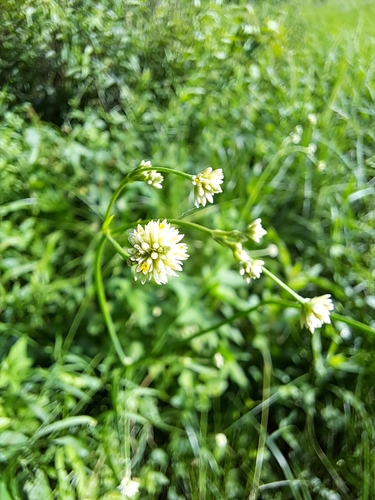
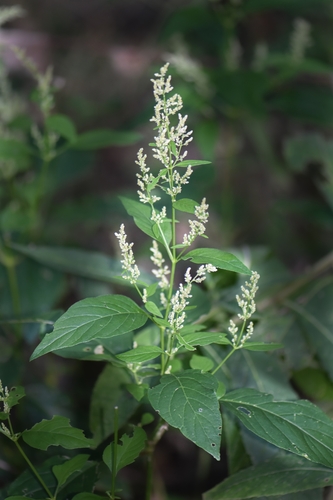
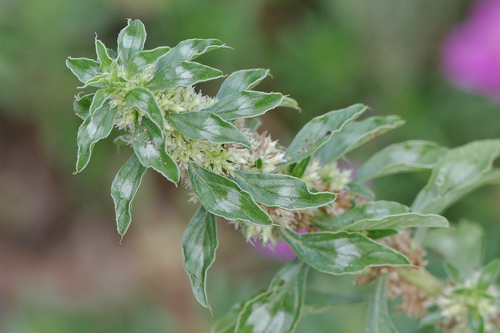
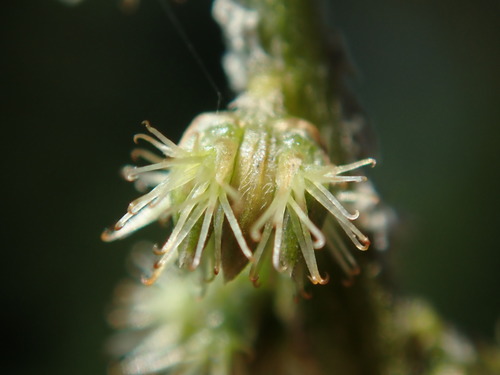
Cyathula prostrata (L.) Blume is a species of perennial prostrate herb. Its leaves are opposite, rhomboid, acute at both ends, thinly pubescent, and petiolate. Inflorescences are terminal, slender spikes, growing either solitary or in groups of three. Flowers occur in clusters of 3 to 5, with one perfect flower and the remaining being neuter. Bracts and bracteoles are similar in shape: lanceolate, acuminate, and pubescent. There are 5 free tepals, which are elliptic and acute; tepals of neuter flowers are shaped like hooked awns. The androecium has 5 stamens, with filaments united into a membranous truncate cup; membranous staminodes alternate with the stamens and are fimbriate. The gynoecium has an ovoid ovary, a simple style, and a capitellate stigma. Fruits are achenes that are obovoid, compressed, and golden brown. The species flowers and fruits from September to April. Its native range covers much of Africa, including Benin, Burkina, The Gambia, Ghana, Guinea, Guinea-Bissau, Ivory Coast, Liberia, Mali, Nigeria, Senegal, Sierra Leone, Togo, Cameroon, Central African Republic, Congo, Equatorial Guinea, Gabon, Gulf of Guinea Islands, Zaïre, Ethiopia, Sudan, Tanzania, Uganda, Angola, Malawi, Mozambique, Zambia, Zimbabwe, and Madagascar. It is also native to temperate Asia, specifically South-Central China, Southeast China, Hainan, and Taiwan, and to tropical Asia, including Assam, Bangladesh, East Himalaya, India, Nepal, Sri Lanka, Cambodia, Laos, Myanmar, Thailand, Vietnam, Borneo, Jawa, Lesser Sunda Islands, Peninsular Malaysia, Maluku, Philippines, Singapore, Sulawesi, Sumatera, Bismarck Archipelago, New Guinea, and Solomon Islands, as well as the Caroline Islands in the Pacific. Its introduced range includes Bolivia, the Caroline Islands, Cook Islands, French Guiana, Guyana, Jamaica, Leeward Islands, Marquesas, Mauritius, Puerto Rico, Réunion, Seychelles, Society Islands, Suriname, Trinidad-Tobago, Tubuai Islands, Venezuelan Antilles, and Windward Islands. Locally, this plant is used as medicine, food, and a source of soap. It is also recorded as a larval host plant for the Fulvous Pied Flat butterfly.