About Cyathophorum bulbosum (Hedw.) Müll.Hal.
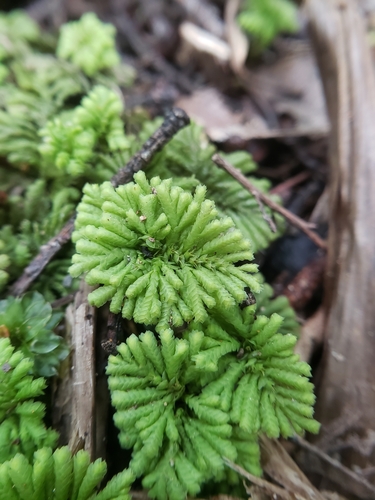
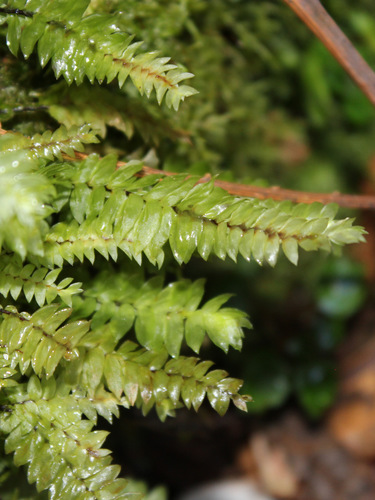
Cyathophorum bulbosum (Hedw.) Müll.Hal. is often mistaken for a small fern because of its appearance. Its stem can reach up to 20 cm in length, though most specimens are between 5 and 15 cm long; longer individuals are found in Tasmania and Victoria. Stems are usually single shoots with distichous (evenly paired) and complanate (flattened) leaf arrangement, but occasional forked stems are not uncommon. Stems grow at a nearly horizontal angle, forming attractive overlapping clumps. The plant also has a smaller, rounder row of leaves on its underside, which can lead people to mistake it for a leafy liverwort. When leaves are examined closely with a hand lens, a short costa (midrib nerve) can be seen, which immediately distinguishes it from liverworts. Note that some leafy liverworts do have a one-cell-thick mid-leaf line called a vitta. Sporophytes develop on the underside of the plant, arranged evenly along the stem. The capsules are subglobose to ellipsoidal in shape, with a fleshy, pale to dark brown calyptra. They are attached to a very short setae (stalk). The operculum is long-rostrate, meaning it has an apical beak that narrows to a slender tip. Cyathophorum bulbosum is dioicous, which means male and female reproductive structures are borne on separate individual gametophytes. Its life cycle is dominated by the gametophyte stage. No other moss species in Australia have a similar appearance, though it may be confused with Schistochila lehmanniana. Cyathophorum bulbosum grows on soil, rocks, tree bases, rotting logs, and the trunks of tree ferns. It prefers moist, shaded sites, generally located near streams or permanent water sources. It is common in temperate rainforest and wet sclerophyll forest. It is the only species of the genus Cyathophorum that occurs in Australia.