About Cyanoramphus novaezelandiae (Sparrman, 1787)
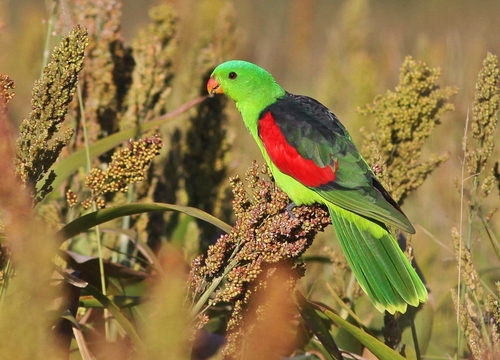
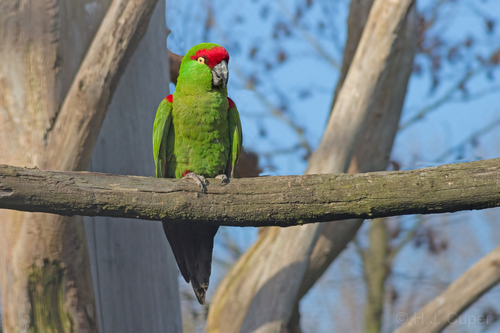
The red-crowned parakeet, with the scientific name Cyanoramphus novaezelandiae, is also called the red-fronted parakeet, and is known as kākāriki in Māori. It is a small parrot native to New Zealand. This species is identified by its bright green feathers and a distinct red pattern on its head. It is a versatile species that feeds on a wide range of food items and can live in many different habitat types. Previously, it was classified as near threatened, because invasive predators pushed the species out of much of its historical range, but it is now categorized as least concern. While it once occupied all of New Zealand's main islands, it is now restricted to only a few areas of the mainland and several offshore islands. Red-crowned parakeets inhabit a very broad variety of habitats, including dense temperate rainforests, coastal forests, scrubland, forest edges, and open areas. Where their range overlaps with that of yellow-crowned parakeets, red-crowned parakeets prefer forest edges and open areas. Historically, red-crowned parakeets were widespread across both the North and South Islands of New Zealand. Today, most of the species' mainland populations have been lost due to predation by introduced species. On the North Island mainland, the species is found in large forest blocks in Northland, the Coromandel Peninsula, and the central North Island. On the South Island, red-crowned parakeets have been recorded along the West, South, and South-East coasts, but these mainland populations remain extremely rare. The rest of the species' population is restricted to Stewart Island / Rakiura, a number of offshore islands such as Kapiti Island, Tiritiri Matangi Island, and Matiu / Somes Island, and the Auckland Islands to the south. Other subspecies of this parrot live on their respective islands, the Kermadec Islands and the Chatham Islands.