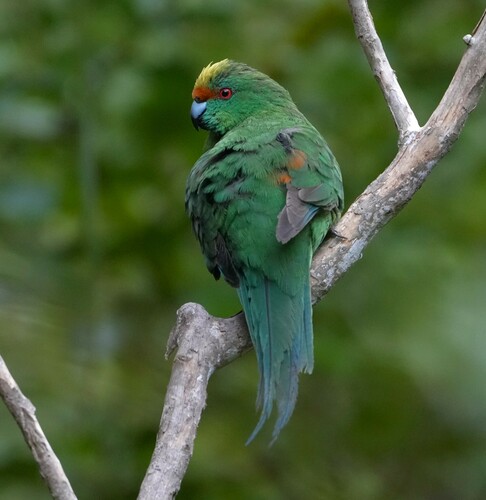
About Cyanoramphus malherbi Souance, 1857
Cyanoramphus malherbi, commonly called the orange-fronted parakeet, is a medium-sized parrot that reaches approximately 20 centimeters in length. Its body is mainly bright blue-green, with azure blue primary covert and leading-edge feathers on its wings. It has a distinctive, diagnostic orange frontal band paired with a lemon yellow crown. This marking is absent in juvenile birds, which have a pale yellow band instead. The orange frontal band starts to develop when the bird is 2 to 5 weeks old. It has orange patches on the sides of its rump. Male birds generally have brighter coloration, while juveniles have distinctly duller plumage. Mature orange-fronted parakeets can only be reliably distinguished from the similar yellow-crowned parakeet (C. auriceps) by the color of the frontal band and rump, though more subtle differences in size, plumage color, and habits also exist. This species is found in just three regions of New Zealand’s South Island: the South Branch Hurunui River Valley, Hawdon River Valley, and Poulter Valley. Additionally, orange-fronted parakeets (known locally as kākāriki karaka) have been translocated to Te Hoiere / Maud Island, Oruawairua / Blumine Island, Chalky Island, Mayor Island / Tūhua, Pukenui / Anchor Island, and the Brook Waimārama Sanctuary in Nelson. Most of these translocated island populations are no longer persistent. Only Blumine Island and the Brook Waimārama Sanctuary hold significant populations, while the Anchor Island population is still in the establishment phase. On the South Island, this parakeet occurs predominantly in Nothofagus/Fuscospora (beech) forest, with some records from alpine and subalpine tussock grassland, and open matagouri shrubland.