About Cyanomitra olivacea (A.Smith, 1840)
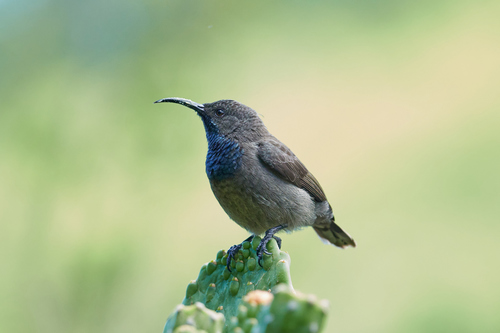
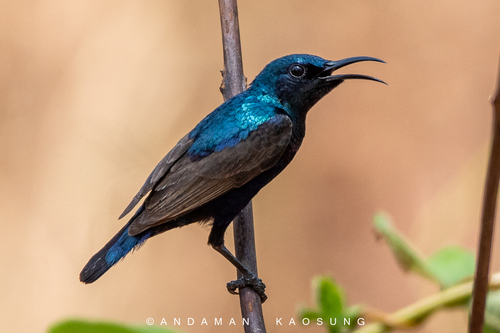
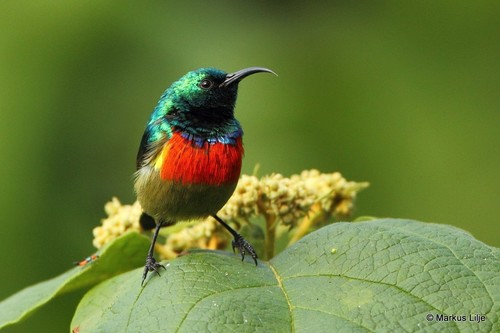
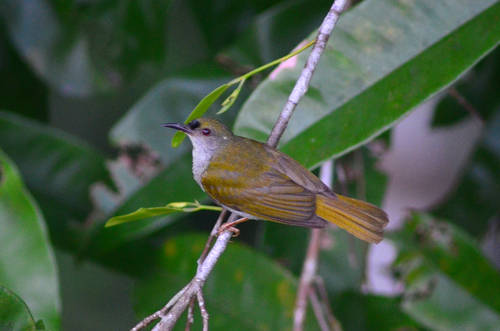
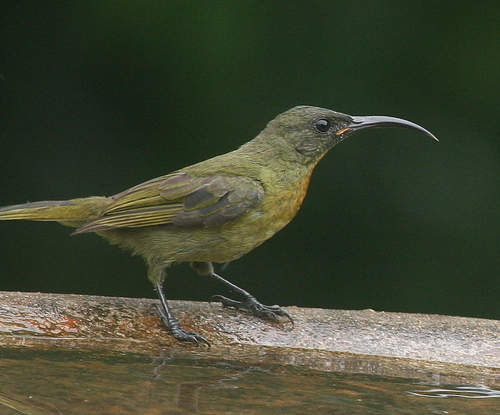
The olive sunbird (Cyanomitra olivacea) is a large sunbird, with body measurements that vary by subspecies and sex: overall body length ranges from 12 to 15 cm, mass from 6.2 to 15 g, wing length from 50 to 73 mm, bill length from 20 to 29 mm, and tail length from 35 to 66 mm. Its body coloration varies from fully dark olive to dull olive, with a paler olive-yellow or olive-grey underside. It has a long, downward-curved beak whose color varies by subspecies, ranging from solid black to mottled grey, beige, or yellow-orange. For eastern subspecies, both males and females can have yellowish-orange pectoral tufts, while only males of western subspecies bear these tufts. Olive sunbirds show morphological differences between forest-savanna boundaries despite having minimal genetic variation. Adult males from forest-savanna boundary habitats have longer wings, legs, and bills than adult males that live in forest habitats. Clutches of olive sunbird eggs contain between one and three eggs. Egg color varies, including shades of grey, grey-white, or brown-grey, with either greyish-brown streaks or mottling in olive-grey, grey-green, violet-grey, yellowish-brown, or dark brown. Egg size ranges from 12 to 19.4 mm, varying by subspecies. Olive sunbirds live in a wide range of habitats, including coastal and montane scrublands, woodlands, bushy and coastal thickets, and western mangroves. They occur throughout primary and secondary forests at all heights, and especially prefer forest understories. They also live in modified habitats, such as agricultural lands, forest clearings, gardens, urban areas, bushes around villages, and active or abandoned eucalyptus, banana, and coffee plantations. Their altitudinal range extends from sea level to 3000 m above sea level, though they most often occur below 2300 m. Olive sunbirds are primarily sedentary, but do partially migrate to lower elevations during cold seasons and higher elevations during warm seasons. Proposed explanations for this seasonal movement include compensating for seasonal temperature changes, females seeking cooler environments for optimal breeding conditions, and the species' high movement capability. Additionally, olive sunbirds are highly mobile, and can cross forest gaps as well as move between fragmented forest patches and eucalyptus plantations.