About Cyanolanius madagascarinus (Linnaeus, 1766)
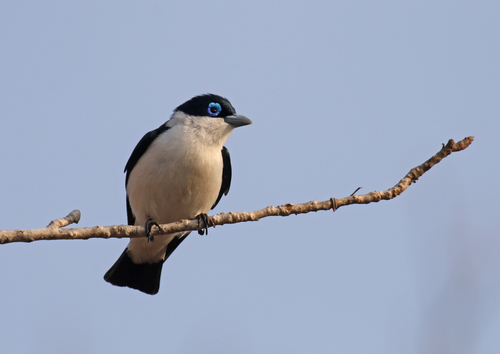
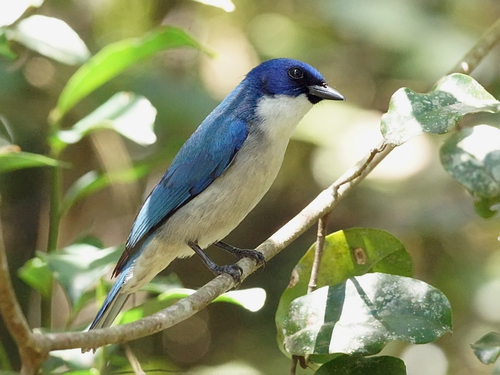
The blue vanga (Cyanolanius madagascarinus) measures 16–19 cm (6.3–7.5 in) in length and weighs 19.5–25.5 g (0.69–0.90 oz). Adult males have bright blue plumage, with a black line running through the eye that extends to the base of the bill, both above and below the bill. They also have a paler blue eye-ring. The tail, and the edges and tips of the wings are black. The throat and underparts are bright white. Females are typically slightly duller in color than males, and their underparts are off-white with a pale orange or light buffy wash. Their wings have a slight greenish tinge. Juveniles have a grayish-blue head, while the rest of their upperparts are dark greenish olive. Their tail has a similar appearance to that of an adult female, but with a duller green-blue pattern. The juvenile throat is dirty-white, and the rest of the underparts are olive-buff. Cyanolanius madagascarinus adults have a vivid pale or cold blue bill: adult males have a dark tip and dark cutting edges, while adult females have a dark brown bill with the same dark pattern on the tip and cutting edges. Juveniles have a black bill with a pale pink base. The iris is sky-blue or greenish blue in males, and brown in both females and juveniles. The legs are black in males and gray in females. This species is found in northern, eastern, and western Madagascar. In the western part of its range, it inhabits the midstory and canopy of deciduous dry forests, and also occurs in evergreen humid forest in western Madagascar. It has additionally been observed in littoral forests, adjacent second growth, and even mangroves. It generally occurs up to an elevation of 1,200 m (3,900 ft), though there are reports of individuals found as high as 1,600 m (5,200 ft).