About Cyanocorax yucatanicus (Dubois, 1875)
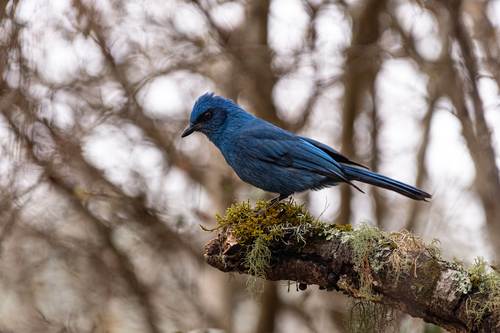
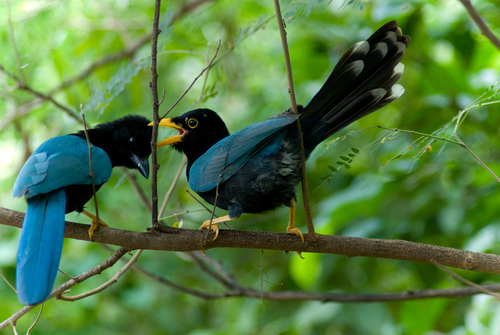
Adult Yucatan jays (Cyanocorax yucatanicus) have black heads, napes, and underparts, with distinctly blue backs, wings, and tails. They have black irises, black eye rings, black beaks, and yellow legs and feet. There are no visible differences between male and female individuals.
This species is primarily native to the Yucatán Peninsula, covering northern Belize, Guatemala’s northern El Petén Department, and the Mexican states of Yucatán, Quintana Roo, and Campeche. It also occurs in parts of the adjacent Mexican states of Chiapas and Tabasco. Habitat preferences differ slightly between the two recognized subspecies. The nominate subspecies C. y. yucatanicus is most common in both humid and scrubby forests, and can also live in coastal scrub. C. y. rivularis, which occurs in the southwestern part of the Yucatan peninsula, can live in nearly any forest type, and is additionally found in pine forests and swamps, though it is not common in those two habitats. Both subspecies occur at elevations up to 500 m (1,600 ft), and the Yucatan jay is a non-migratory species.