About Cyanocompsa parellina (Bonaparte, 1850)
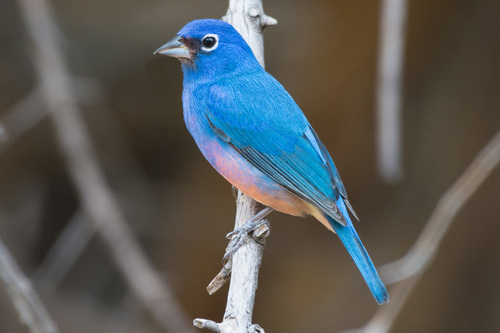
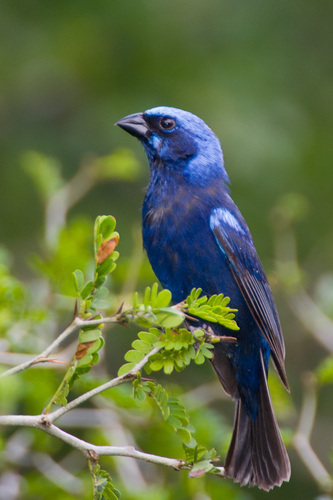
Cyanocompsa parellina, commonly called the blue bunting, has several recognized subspecies with distinct physical traits. The nominate subspecies measures 13 to 14 cm (5.1 to 5.5 in) in length; males weigh 11 to 24 g (0.39 to 0.85 oz) and females weigh 9.8 to 21 g (0.35 to 0.74 oz). Nominate subspecies males display a range of blue shades: sky blue on the forehead and cheek, blackish blue on the upperparts, ultramarine on the rump, and deep blue on the underparts from the chin to the belly. Adult and immature females are overall dull brownish, with a reddish tinge on the belly. Immature males are overall gray-blue with a brownish wash on the belly. Compared to the nominate subspecies, male C. p. beneplacita are a duller blue, while females are paler and have less reddish tinge on the belly. Male C. p. lucida have blue coloring between that of the nominate and C. p. beneplacita, and sky blue covers more of their head; females are similar to female C. p. beneplacita. Male C. p. indigotica are dull indigo on darker areas and cerulean on lighter areas, and females are lighter brown than nominate females. Each subspecies has a distinct geographic range. The nominate subspecies is the most widespread, occurring from Veracruz in eastern Mexico south and east through Belize, Guatemala, Honduras, and El Salvador into northwestern Nicaragua. C. p. beneplacita is mostly confined to Nuevo León in northeastern Mexico, though it occasionally wanders into Texas and Louisiana in the United States. C. p. lucida is found in northeastern and eastern Mexico. C. p. indigotica ranges across western Mexico from Sinaloa south to Oaxaca and Chiapas. The blue bunting inhabits dense vegetation including scrubby areas, thickets, and the undergrowth and edges of tall forest. In terms of elevation, its range reaches up to 1,800 m (5,900 ft) in Mexico and up to 900 m (3,000 ft) in Guatemala.