About Cyanistes cyanus (Pallas, 1770)
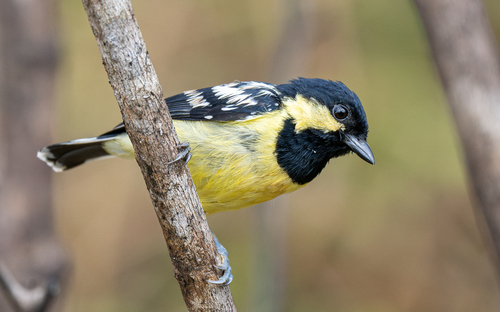
The azure tit, scientifically known as Cyanistes cyanus, is a passerine bird belonging to the tit family Paridae. It is a widespread and common resident breeder found across Russia, Central Asia, northwest China, Manchuria, and Pakistan. Its habitats include temperate and subarctic deciduous or mixed woodlands, scrub, and marshes. As a resident species, most individual azure tits do not migrate. The species nests in tree holes and lays approximately 10 eggs per clutch. When disturbed, the bird sits tightly on its nest and displays defensive behaviors such as hissing and biting. Its diet is primarily made up of insects, seeds, small invertebrates, insect larvae, and eggs. The azure tit measures 12–13 cm (4.7–5.1 in) in length and has a distinct, easily identifiable plumage. Its head, tail corners, wing bars, and underparts are white, while its upperparts are blue. It also has a characteristic dark line running through its eye. The azure tit is the eastern counterpart of the common Eurasian blue tit. It can hybridize with the common Eurasian blue tit, but hybrid offspring usually have a blue crown, unlike the white crown of pure azure tits. Its calls are similar to those of the blue tit, consisting of repeated dee, dee, dee notes or a scolding churr. Its song is a repeated tsi-tsi-tshurr pattern, which has been described as intermediate between the songs of the blue tit and the crested tit. There are documented records of this species occurring in other parts of Europe, including Finland, Sweden, Poland, and Austria.