About Cyanistes caeruleus (Linnaeus, 1758)
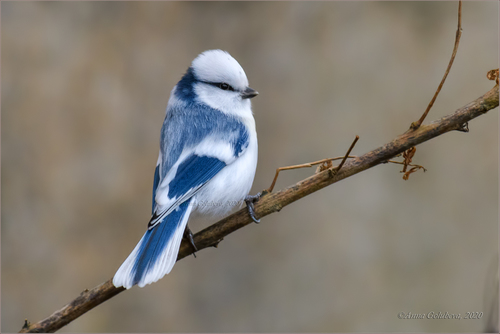
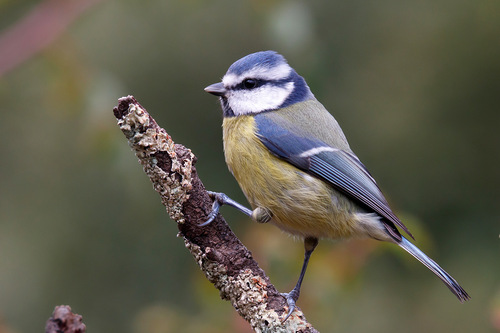
The Eurasian blue tit, scientifically Cyanistes caeruleus (Linnaeus, 1758), is typically 10.5–12 cm (4.1–4.7 in) long, with a wingspan of 17.5–20 cm (6.9–7.9 in) for both sexes, and weighs around 11 g (0.39 oz). A standard adult blue tit has an intensely blue crown, with a dark blue line running through the eye and circling the white cheeks and chin, creating a very distinctive look. The forehead and a wing bar are white. The nape, wings and tail are blue, while the back is yellowish green. Most underparts are sulphur-yellow with a dark line running down the abdomen; the intensity of this yellow colour shows how many yellow-green caterpillars the bird has eaten, because the diet brings in high levels of carotene pigments. The bill is black, legs are bluish grey, and irises are dark brown. The sexes look similar and often cannot be told apart by the unaided human eye, but under ultraviolet light, the male’s crown is a brighter blue. Juvenile birds are yellower overall, with less colour contrast. They start to look like mature birds by September, though they keep some distinct wing markings until May or June of the next year. Blue tits can also see ultraviolet light, which is one method they use to tell males, females, and juvenile birds apart. A male’s cap is a more intense shade of blue than the cap of a female or chick. There are currently around 20 to 44 million breeding pairs of Eurasian blue tits in Europe. The Eurasian blue tit and its hybrids are considered native to areas of the European continent with mostly temperate or Mediterranean climates, as well as parts of the Middle East. These native areas include Ireland, the United Kingdom, most of the European Union and EFTA (except Malta, where they are considered vagrants, and Iceland, where they are entirely absent), plus Albania, Andorra, Armenia, Azerbaijan, Belarus, Bosnia and Herzegovina, Georgia, Iran, Iraq, Jordan, Kazakhstan, Lebanon, Libya, Moldova, Montenegro, North Macedonia, Russia, San Marino, Serbia, Syria, Turkey, Vatican City and Ukraine. Populations from northwest Africa and the Canary Islands, formerly classified as Eurasian blue tits, are now recognised as a separate species. In Great Britain, the Eurasian blue tit lives in a wide range of environments, and is most often found in deciduous woodland, parks, gardens, and even in the centres of towns. Eurasian blue tits form mixed winter flocks with great tits, and blue tits are likely better at balancing on slender twigs. A Eurasian blue tit often climbs tree trunks in short, jerky hops, a movement similar to that of a treecreeper. The bird usually roosts in ivy or evergreens, but during harsh winters it will roost in any available small hole, whether that hole is in a tree or a nesting box. They are very agile and can hang from almost any surface. They are a common and popular garden bird across Europe, well known for their perky acrobatic displays when they visit bird feeders. They will swing beneath feeders while calling a repeated "tee, tee, tee" or a scolding "churr". The Eurasian blue tit’s diet is mostly made up of insects, spiders, and other small invertebrates, but it will also eat fruits and seeds when it is not breeding season. The small animal prey they take includes springtails (Collembola), grasshoppers (Orthoptera), damselflies (Odonata), earwigs (Dermaptera), moths (Lepidoptera) and lacewings (Neuroptera). They often capture food while hanging upside-down. While foraging, they probe into open buds and peel bark from hazel trees (Corylus). They rarely hover and only very occasionally forage on the ground. They regularly visit bird tables, and will take bread, cheese, fat, and a variety of seeds, especially sunflower seeds (Helianthus). Large seeds are carried to a nearby branch, where the bird opens them by holding the seed with one foot while hammering it open with its bill.