About Cyanea versicolor Agassiz, 1862
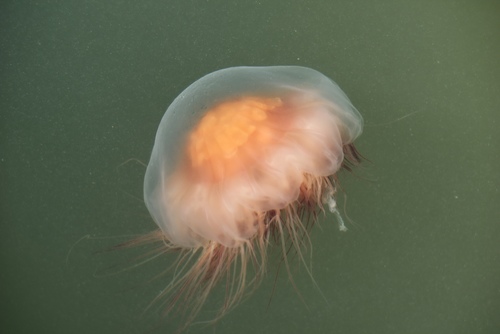
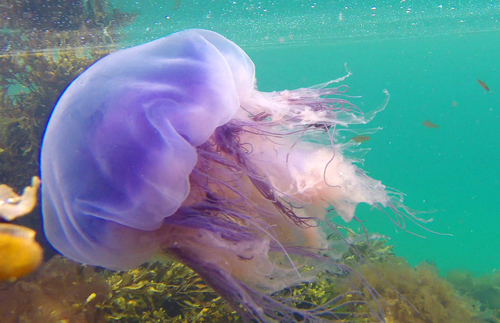
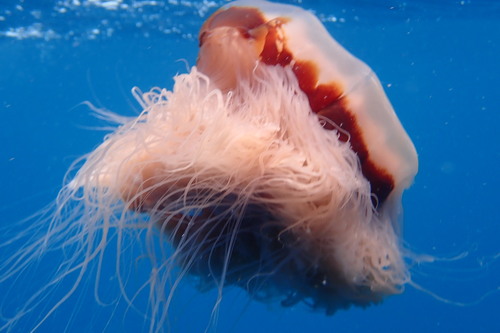
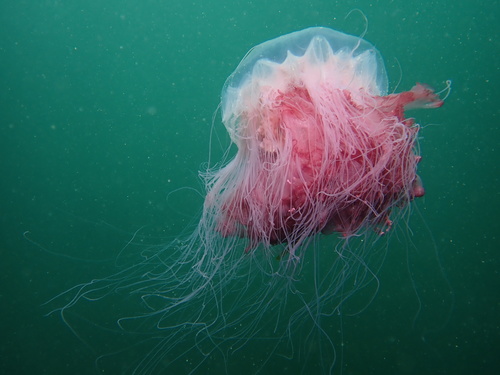
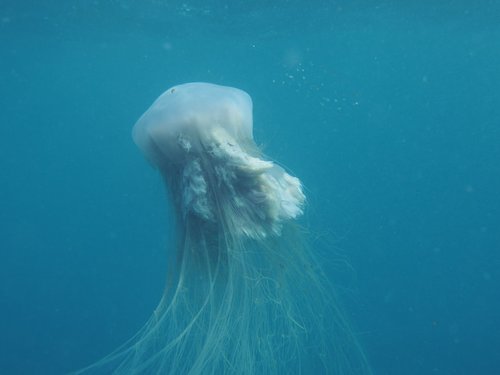
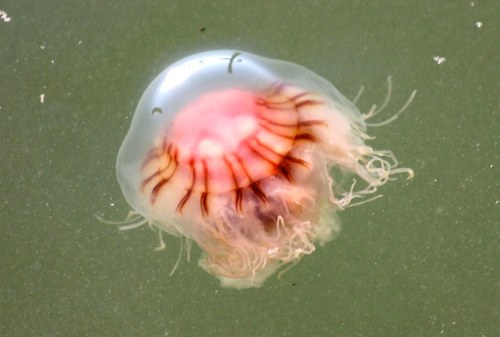
Scientific name: Cyanea versicolor Agassiz, 1862. This description is taken from Medusae of the World Vol. III (1910). This form bears the same relation to Cyanea arctica var. fulva as fulva does to the northern C. arctica. It is smaller than fulva, and is especially distinguished by its pink coloration. Mature medusae are about 10 mm in diameter, and are found in swarms off the coast between Cape Hatteras, North Carolina, and Cape Canaveral, Florida. They are practically confined to pure open water and do not frequent harbors. Mature medusae carry many ball-like clusters of developing planulae gathered into the peripheral canals of the gastric space. The gelatinous substance of the disk is translucent milky-blue, while the gastrovascular space, gonads, radial and circular muscles of the subumbrella, and the entodermal cores of the tentacles are purplish-pink. The outer parts of the veil-like folds of the palps are amber-brown, while the parts adjacent to the mouth are pink. The concretions of the 8 sense-organs are reddish-brown. The planulae are yellow, but the ephyra is pink. The curtain-like oral fringes are relatively smaller than in Cyanea arctica. The main distinguishing feature of C. versicolor is its characteristic pink coloration. Even in young ephyrae only 2.5 mm in diameter, the stomach cavity shows a deep purplish-pink, which is very different from the pale yellow ephyra of the southern C. fulva. Mature medusae of C. versicolor occur in the winter months along the southern coast of the United States. Among thousands of individuals observed by the author during the winter of 1904-05, not more than a dozen lacked the pink coloration, and these resembled the variety C. capillata var. fulva. These atypical individuals were swimming among swarms of typical pink C. versicolor medusae. The variety versicolor appears to be a well-marked local race of Cyanea capillata. Its range covers the marine ecoregions of Northern Gulf of Mexico, South Florida/Bahamian Atlantic, Carolinian Atlantic, and Virginian Atlantic. It lives in coastal and estuarine habitats. Its diet consists of most types of zooplankton, including ctenophores, hydromedusae, and other scyphozoans.