About Cyanea nozakii Kishinouye, 1891
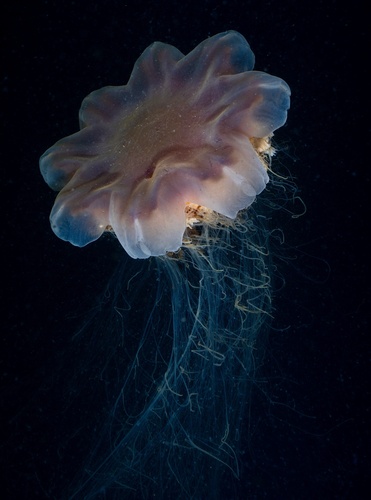
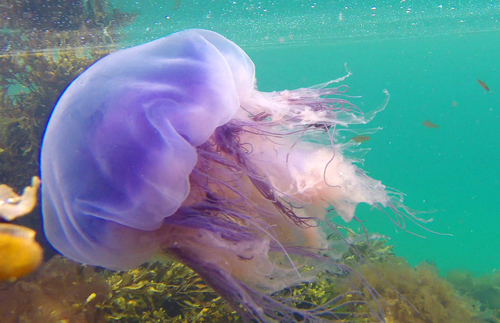
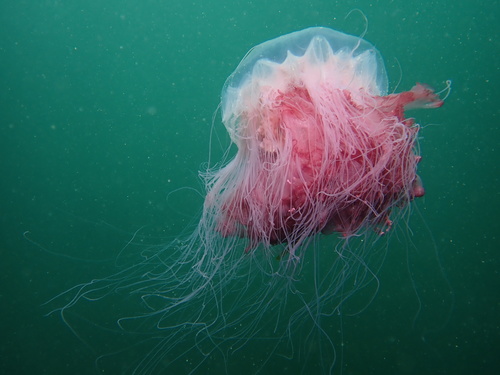
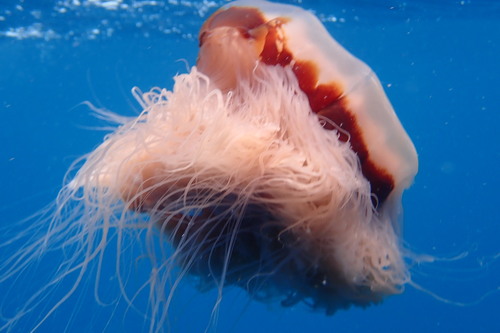
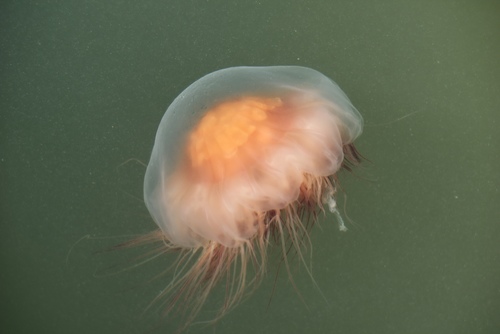
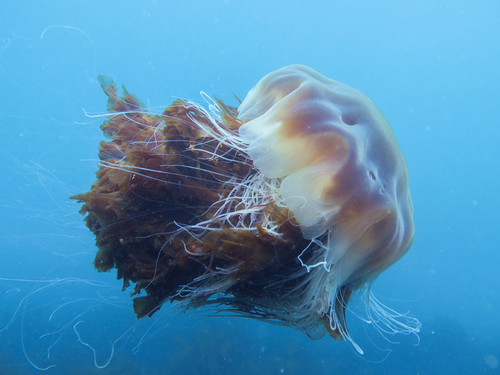
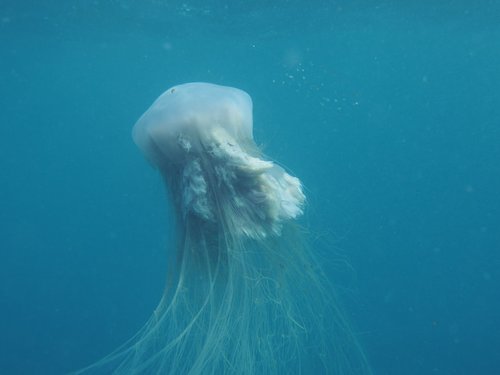
In its medusa life stage, Cyanea nozakii has a distinctive flat-topped bell that can reach up to 50 centimetres (20 inches) in diameter. The bell is typically cream or pale yellow with a dark center and a translucent rim. It has eight large marginal lobes and eight bundles of thread-like marginal tentacles. Each bundle may hold one hundred or more tentacles, which are either translucent or reddish and can extend up to 10 metres (33 feet). Under the center of the bell is the manubrium, and the mouth is surrounded by a tangled mass of rusty-brown or orange oral tentacles. Cyanea nozakii is found along the coasts of China and Japan. Since the start of the 21st century, this species has become more common, with large mass aggregations forming. In 2004, such an aggregation occurred in Liaodong Bay, Northeast China, and was observed to negatively impact commercial catches of the edible jellyfish Rhopilema esculentum. In 2011, a bloom of large jellyfish appeared off the coast of Qingdao, an event that contradicted a Japanese scientist's prediction that it would be a "non-jellyfish year". This bloom consisted largely of Nemopilema nomurai, Aurelia aurita, and Cyanea nozakii. The Institute of Oceanology, Chinese Academy of Sciences has conducted research into the development of these blooms and their social and ecological effects. A 2014 report from this study found that such blooms are likely an indicator of declining ecosystem health. Blooms are linked to variations in sea temperature, increased coastal water pollution, Chinese overfishing, bottom trawling, and depleted oxygen levels caused by algal blooms. All these factors improve survival conditions for the polyp stage of the jellyfish life cycle, leading to higher numbers of medusa jellyfish. Multiple species of juvenile fish associate with Cyanea nozakii, gaining protection from the jellyfish's stinging tentacles. Two recorded species that do this are the razorbelly scad Alepes kleinii and the Malabar trevally Carangoides malabaricus. Large numbers of tiny fish congregate around and among the jellyfish's fine tentacles. Each fish either avoids contact with the tentacles or is relatively unaffected by their mild sting. If the jellyfish is caught in a net, the small fish remain with it, often receive more severe stings, and consequently die. As the fish grow larger, they leave the jellyfish and live independently. Another organism that forms an association with this jellyfish is the stalked barnacle Alepas pacifica, which hangs from the margin of the bell. The barnacle is translucent and matches the whitish colour of the jellyfish's bell, making it inconspicuous. It is a permanent resident that always associates with the jellyfish, and takes advantage of the rich food supply in the surface waters where the jellyfish floats.