About Cyanea lamarckii Péron & Lesueur, 1810
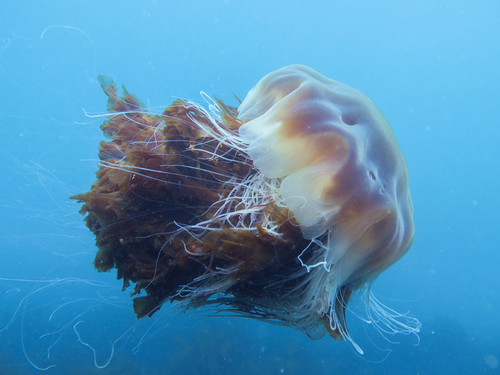
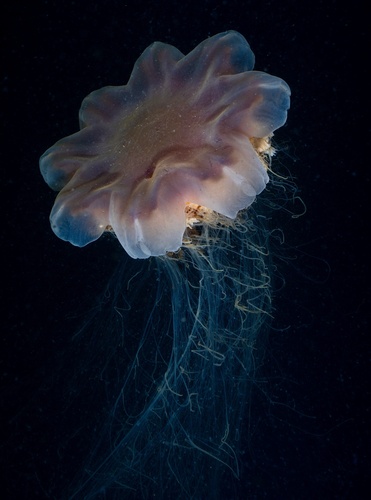
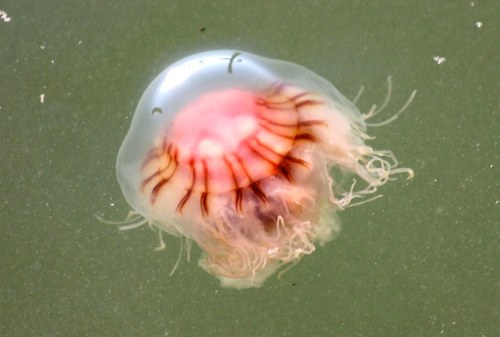
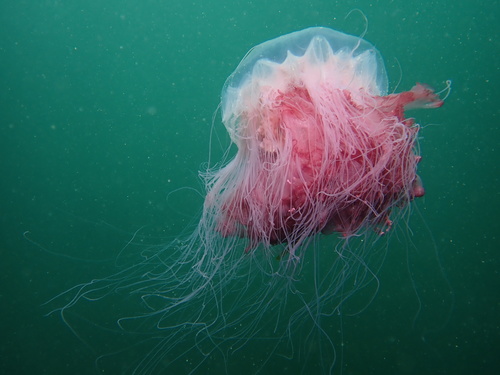
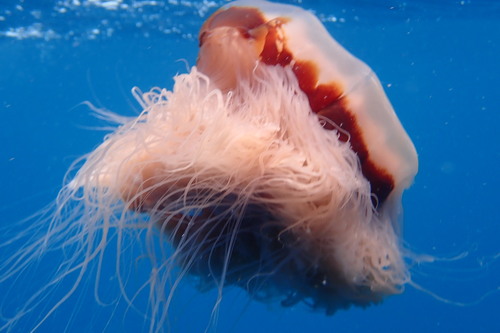
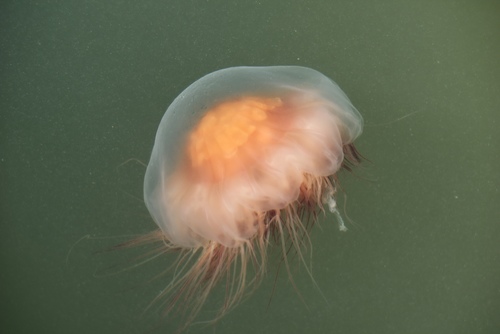
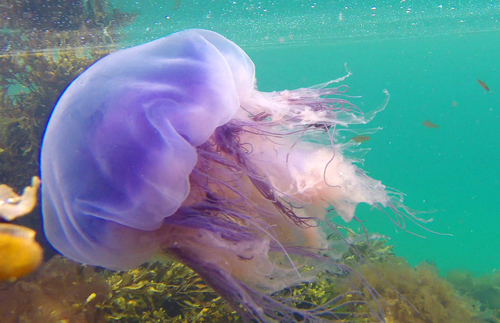
Cyanea lamarckii, commonly known as the blue jellyfish, can be aged by the color of its bell. Young individuals are typically pale in appearance, while mature blue jellyfish develop a brightly purple-blue bell; some mature individuals have yellow bells. While this species is similar to the lion's mane jellyfish, the blue jellyfish is smaller, and has a translucent bell. C. lamarckii has an overall blue or yellow tone, and its bell grows to approximately 10 to 20 cm (4 to 8 in) across. Exceptional specimens can reach 30 cm (12 in) across the bell; in Scandinavian seas, this species rarely grows larger than 15 cm (6 in). These jellyfish drift closer to shore to use their tentacles to catch the large local population of plankton. This species has many stinging tentacles, and its four large mouth arms have many wrinkles and ripples. The blue jellyfish feeds on phytoplankton, zooplankton, and the eggs and larvae of other aquatic animals including fish. C. lamarckii uses nematocysts contained in its tentacles both to catch prey and to protect itself from predators. This species is found in the pelagic zone off the west coast of Scotland, the North Sea, the English Channel, and the Irish Sea, where it sometimes occurs alongside the more common lion's mane jellyfish (Cyanea capillata). It is also found in the Kattegat along Sweden's western coast, and in Danish waters. Around the British Isles and the southern North Sea, medusae bud and detach from mature polyps between January and March. This stage of its life cycle proceeds in a similar way to that of the moon jellyfish. Blue jellyfish live for less than one year.