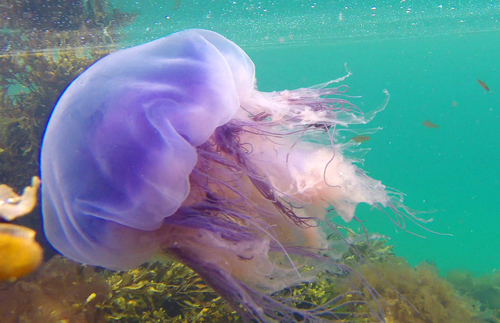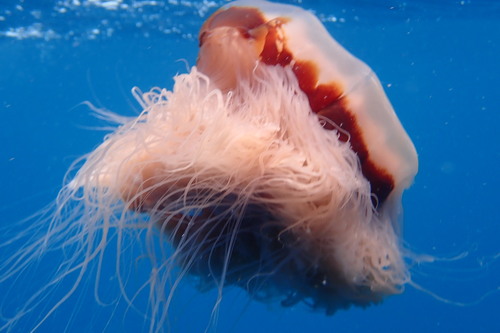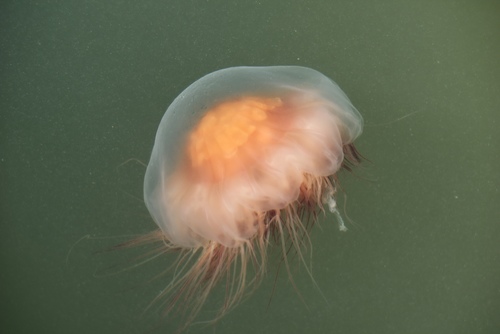
About Cyanea fulva Agassiz, 1862
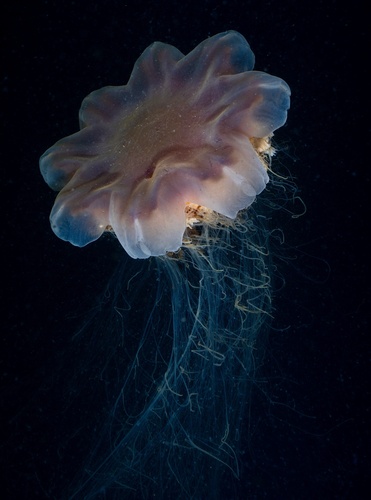
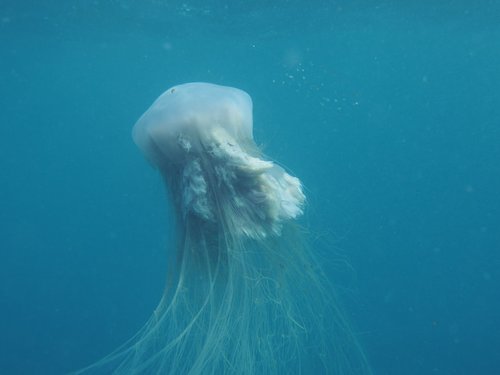
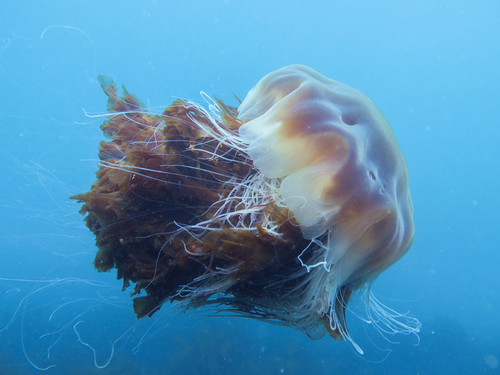
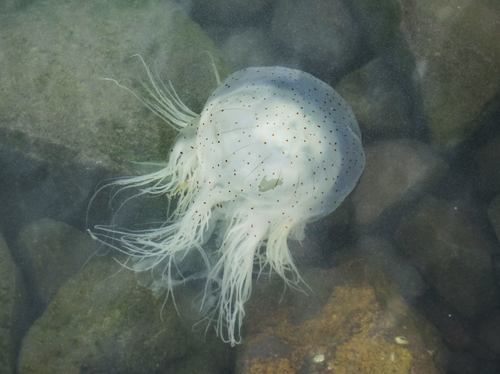
Cyanea fulva, first described by Agassiz in 1862, is recorded to grow to over two inches in bell diameter. It typically reaches larger sizes than populations of C. versicolor, but has a smaller maximum size than populations of C. capillata. Its genital pouches are stretched along the same plane as the lower floor. In young individuals, the four corners of the mouth extend into separate, distinct arm-like appendages. Young C. fulva have only three tentacles per tentacle bunch; these tentacles first develop in clefts between lappets as the bell margins grow outward. Mature C. fulva have four tentacles that extend from broad clusters in each bunch, hanging beyond the actinostome. The tentacles have an overall cinnamon tinge, are darker in the center of the main cavity, and much lighter along the disk margin. The marginal lobes of C. fulva are more rounded and deeper than those of other Cyanea populations, and the bell disks of Cyanea species are larger than the disks of Aurelia species. The stomach cavity corresponds to a pale yellow ephyra. Compared to other Cyanea species, C. fulva has fewer folds than C. arctica populations, but more folds than C. versicolor populations. These folds are notably thin and deciduous; concentric fold areas are comparatively the broadest, while radiating folds are the shortest. Unlike C. capillata, C. fulva has exumbrellar papillae. Larvae are retained in cysts on the parent organism. Like other members of its family, development proceeds through a sessile scyphistoma stage that strobilates to release ephyrae, which eventually mature into medusae. The distribution of C. fulva varies by latitude, and populations are particularly common south of Cape Cod and in Long Island Sound. L. Agassiz (1862) recorded this species in the western Atlantic along the mid-Atlantic United States. Populations of C. fulva peak in midsummer, and individuals regularly appear in Hempstead Harbor in mid-May each year. This species is typically found in shallow water. One study examined the responses of aquatic invertebrates including C. fulva to declining oxygen conditions, with C. fulva populations acclimated to three different temperatures: 5 °C, 10 °C, and 15 °C. Another study found that Cyanea polyps struggle to survive at temperatures above 25 °C. The sting of C. fulva is generally considered moderately painful to humans. Compared to scyphozoan polyps of Aurelia aurita and Chrysaora quinquecirrha, the free amino acid (FAA) composition of C. fulva has a more uniform distribution across its compositional spectrum. A separate study found that Cyanea has the greatest variety of nematocyst types, including a-isorhizas, A-isorhizas, α-isorhizas, heterotrichous anisorhizas, and heterotrichous microbasic euryteles. This study noted marked differences in the relative abundance of α-isorhizas between individual Cyanea ephyrae. α-isorhizas are concentrated in the oral region of the scyphistoma, and do not become equally distributed among the ephyrae produced by a given strobila. The euryteles of C. fulva have a larger average length, ranging from 10.1 to 12.7μm, compared to euryteles from populations of Aurelia aurita, Chrysaora quinquecirrha, and Rhopilema verrilli. Differences in size and distribution of morphologically identical nematocysts have also been observed between Cyanea capillata and Cyanea lamarckii.