About Cyanea capillata (Linnaeus, 1758)
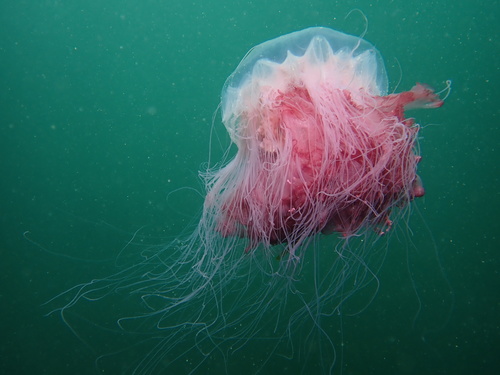
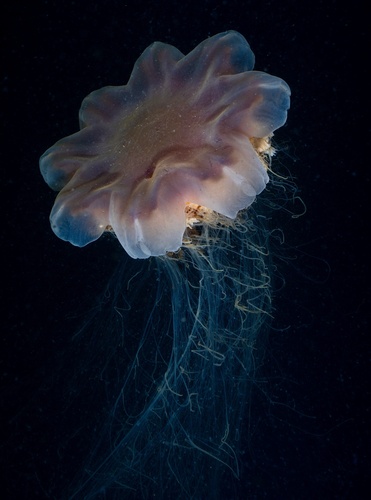
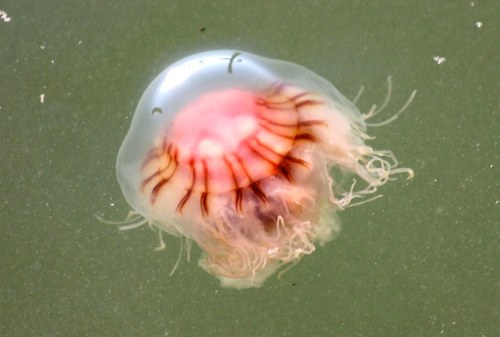
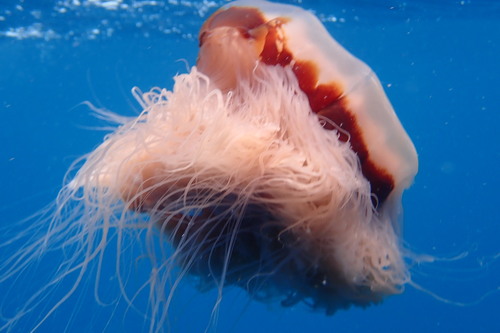
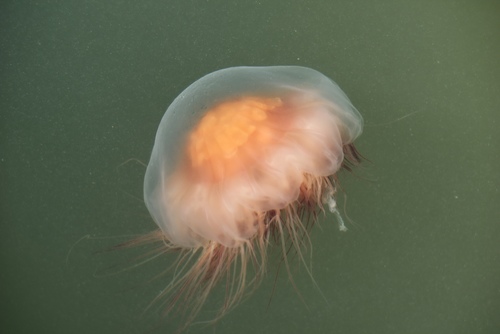
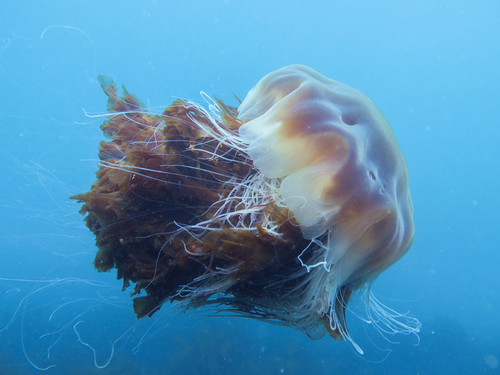
The lion's mane jellyfish, Cyanea capillata, gets its common name from its showy, trailing tentacles that resemble a lion's mane. This species varies greatly in size. While individuals can reach a bell diameter over 2 meters (6 feet 7 inches), jellyfish found in lower latitudes are typically smaller than those in far northern regions, usually growing to a bell diameter of around 50 centimeters (20 inches). Larger lion's mane jellyfish generally live further offshore than smaller individuals. Juvenile lion's mane jellyfish are light orange or tan, and darken to red and purple as they mature. Unlike most jellyfish, which have a circular bell, the lion's mane jellyfish's bell is split into eight distinct lobes, giving it an eight-point star shape. Each lobe holds approximately 70 to 150 tentacles, arranged in four clearly separate rows. A balance organ called a rhopalium sits at each of the eight indentations between the lobes along the bell margin, and this organ helps the jellyfish orient itself. Broad, frilly oral arms covered in stinging cells called cnidocytes extend out from the jellyfish's central mouth. Closer to the mouth, the jellyfish has a total of around 1,200 tentacles. The long, thin tentacles that grow from the bell's subumbrella are described as extremely sticky, and also contain their own stinging cells. In larger specimens, these tentacles can trail as long as 30 meters (100 feet) or more. The longest known measured specimen had tentacles reaching 36.6 meters (120 feet), though some researchers suggest this individual may actually belong to a different Cyanea species. A lack of other published size measurements for Cyanea, plus missing details on how past specimens were measured, has led to skepticism about these extreme reported length records. Even so, this unusual length – longer than a blue whale – gives Cyanea capillata the status of one of the longest known animals on Earth. Lion's mane jellyfish mostly stay close to the ocean surface, staying at depths no greater than 20 meters (66 feet). Their slow pulsations only weakly propel them forward, so they rely on ocean currents to travel long distances. These jellyfish are most commonly sighted in late summer and autumn, once they have reached their full large size and currents start moving them closer to shore. Unlike most pelagic jellyfish, lion's mane jellyfish are completely solitary and rarely travel in groups. The species uses its stinging tentacles to capture, pull in, and eat prey including fish, zooplankton, and smaller jellyfish. Like other jellyfish, lion's manes can reproduce both sexually during their medusa life stage and asexually during their polyp stage. The lion's mane jellyfish has a one-year lifespan with four distinct life stages: larval, polyp, ephyrae, and medusa. Female jellyfish hold their fertilized eggs on a tentacle, where the eggs develop into larvae. Once the larvae are mature enough, the female deposits them onto a hard surface, where they quickly grow into polyps. The polyps then reproduce asexually, forming stacks of small, immature medusae called ephyrae. Individual ephyrae break away from these stacks, and eventually grow into the mature medusa stage to become fully grown lion's mane jellyfish.