About Cuttsia viburnea F.Muell.
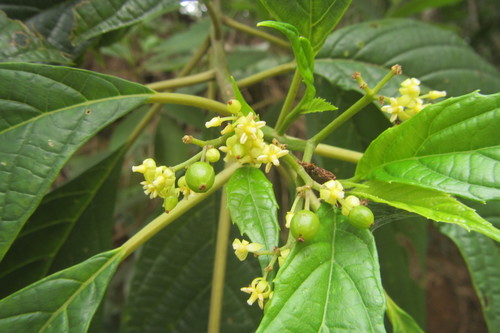
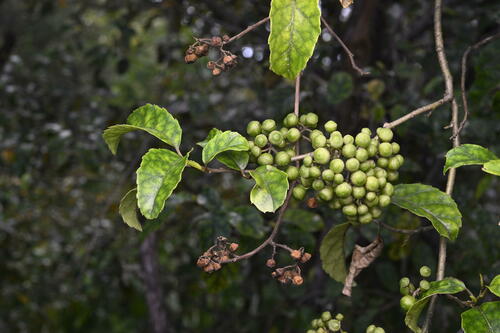
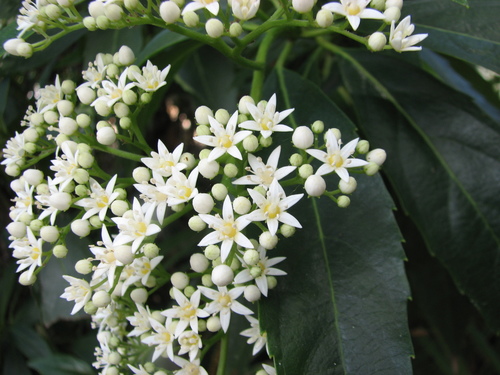
Cuttsia viburnea, commonly known as silver-leaved cuttsia, is a shrub or bushy tree that can reach up to 15 m in height. Its branchlets are initially herbaceous and bear conspicuous lenticels. Young shoots and inflorescences have hairs that lie flat against the surface. Leaves are arranged alternately along the stems, with leaf stalks measuring 1.5–4.5 cm long. Leaf blades are hairless, soft and thin in texture, bright green and shiny on the upper surface with a paler underside. Blades are oval, with the widest point at or beyond the midpoint of the leaf, and measure 8–20 cm long by 2–6.5 cm wide. The base of the blade gradually narrows into the leaf stalk, the leaf margin is evenly toothed with each tooth ending in a gland, and the leaf tip is pointed. Secondary veins branch off the main vein at approximately 45°, curve strongly, and have ends running parallel to the leaf edge. The inflorescence is a multi-flowered panicle 8–18 cm long. Flowers are symmetrical, star-shaped, five-parted (pentamerous), and carry a pleasant honey scent. The five triangular green sepals are less than 1 mm long. The five separate white petals are long, inverted tear-shaped, 3–4 mm long, and have a pointed tip. Five narrow white filaments alternate with the petals, each topped by an anther shorter than the filament that releases cream-colored pollen. Pollen grains are tricolpate, triangular when viewed from the pole and round when viewed from the equator, around 20 μm in size, with a net-like surface structure, and are shed individually rather than in groups of four (as seen under a microscope). A narrow white style rising from a yellowish disc, ending in a five-lobed stigma. Flowering occurs from October to December. The fruit is a green to light brown globose to ovoid capsule 3–4 mm long, with each locule opening separately. Seeds are very small and ovoid in shape. Silver-leaved cuttsia grows along the east coast of Australia between Noosa Heads, Queensland and Newcastle, New South Wales, and also occurs in a small number of isolated locations in the mountains of Queensland. This species grows in subtropical and warm-temperate rainforest, and prefers higher-light locations such as rainforest margins, regrowth areas, and along streams. It is self-infertile. Flowers produce nectar and are visited by many different types of insects. Adult jewel beetles Calodema regalis are reported to feed on Cuttsia viburnea.