About Cussonia arborea Hochst. ex A.Rich.
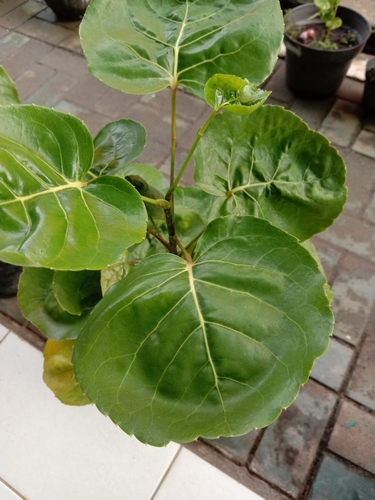
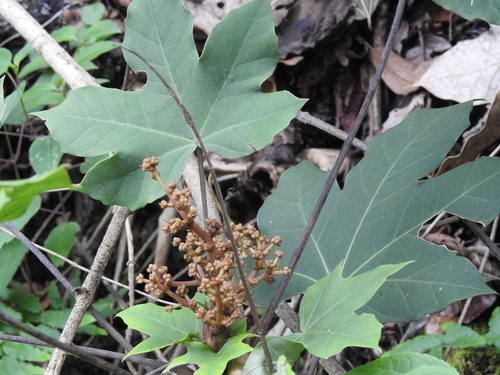
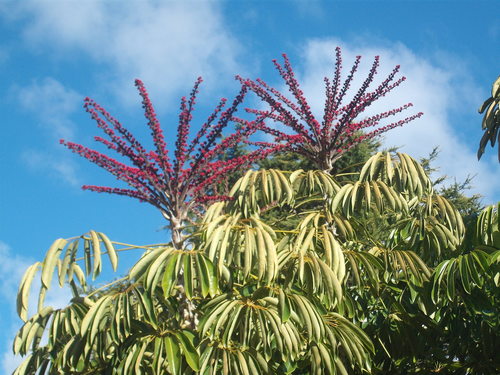
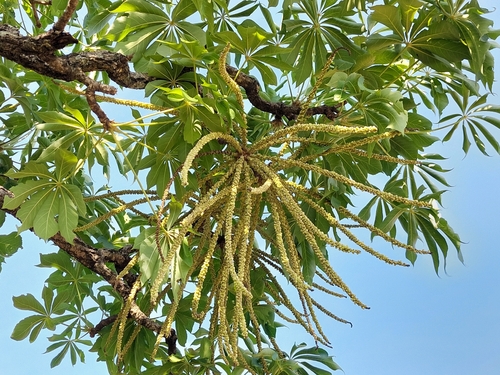
Cussonia arborea Hochst. ex A.Rich. is a multi-branched tree that can reach 15 m in height, with a trunk up to 45 cm in diameter. Its bark is thick, corky, deeply furrowed, and ranges from grey to dark grey in color. Leaves are palmately compound with 3 to 9 leaflets, or occasionally simple. Mature leaves are deeply lobed, with a leathery upper surface that is glabrous to glabrescent; young leaves are typically tomentose. Leaflets measure 6–30 cm long and 2–18 cm wide, with an obovate to elliptical outline. Leaflet margins are most commonly entire to crenate, apexes are acute or acuminate, and bases are cuneate. Flowers are arranged in umbels of spikes that point in multiple directions, with up to 15 spikes per umbel. Fruits are globose or ovoid, dark purple, and grow up to 5 mm long. This species is widely distributed across West, Central, and East Africa: it ranges from Guinea and Senegal in West Africa east to Eritrea and Ethiopia in the Horn of Africa, and south to Zimbabwe. It grows in open forests, woodlands, and savannahs. For traditional medicinal uses, bark decoction is used to treat malaria in Nigeria. In Ghana, Malawi, and Zimbabwe, plant extracts are used to treat mental health related issues. Decoctions made from its leaves are used to treat rheumatism and oedema. A water decoction of bark extract is applied topically to treat gonorrhea, and a root decoction is taken orally to treat diarrhea.