About Cuscuta gronovii Willd. ex Schult.
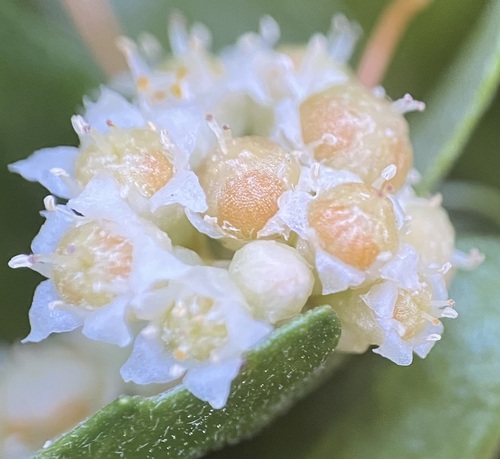
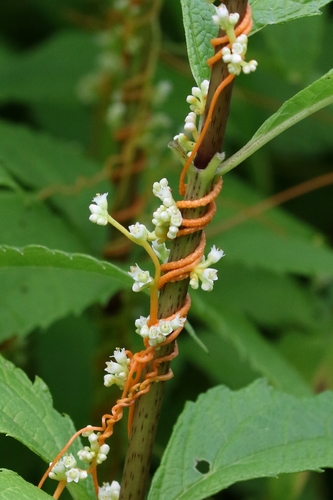
Cuscuta gronovii Willd. ex Schult. is a member of Convolvulaceae, the family that includes morning glories, a family which contains around 200 species total. It is a parasitic annual vine that forms a parasitic relationship with the host plants it infects. Its stems are orange-yellow in color, and the vine can grow to one meter or longer, wrapping and entangling itself around its host plant. While it looks leafless, it actually has very small, alternate, scale-like leaves. The vine produces white flowers that have bell-shaped, five-lobed corollas, and sepals that are joined at the base. Individual flowers are spaced roughly 1/8 of an inch apart from each other. Three subspecies of Cuscuta gronovii are currently recognized: C. gronovii subsp. calyptrata, C. gronovii subsp. gronovii, and C. gronovii subsp. latiflora.
Common dodder, the common name for this species, is native to every US state except Utah, Nevada, California, Washington, Alaska and Hawaii, and to every Canadian province except British Columbia, Yukon, the Northwest Territories, and Nunavut. It has also become naturalized in France, Germany, Luxembourg, the Netherlands, and Italy. It most commonly grows in temperate forest habitats, and because it needs large amounts of moisture, it is typically found in floodplains.
Plants in the genus Cuscuta generally lack chlorophyll and are not photosynthetically active. Cuscuta gronovii does contain a small amount of chlorophyll, but this amount is not enough for the plant to survive through autotrophy alone, so the species relies entirely on host plants to get the nutrients it needs. Its life cycle starts with seed germination, but seeds cannot survive for long periods without connecting to a host plant. Once mature, adult plants wind around their host and begin an attachment phase, where parenchymal cells start developing pre-haustoria. Next comes the penetration phase, where fully developed haustoria puncture through the host plant tissue. This puncture allows water and macromolecules to move from the host to the dodder. While this relationship can harm the host plant, the effects are usually not fatal. Common host plants for Cuscuta gronovii include (but are not limited to) spotted touch-me-not, false nettle, wood nettle, square-stemmed monkeyflower, and ditch stonecrop. This species flowers between July and October, and is pollinated by wasps.