About Cuscuta campestris Yunck.
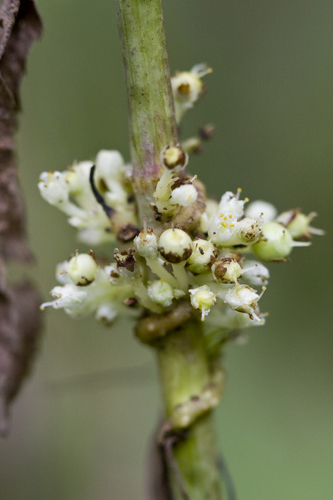
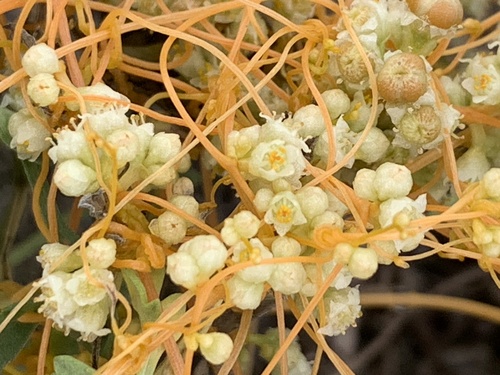
Cuscuta campestris Yunck., commonly called field dodder, is a widespread holoparasitic vine that grows on other host plants. It lacks true leaves and roots, and has very little to no chlorophyll, so it cannot carry out significant photosynthesis and is entirely dependent on host plants for nutrients. Its life cycle begins with seed germination near the soil surface, where it produces thin, pale green to yellow thread-like stems. These stems grow slowly until they contact a host plant, then wrap around the host. Once wrapped, it develops specialized sucker-like absorptive organs called haustoria that penetrate the host’s tissue to steal nutrients. If a seedling does not reach a host plant, it will die quickly; seedlings cannot survive long without a host. Cuscuta campestris uses two mechanisms to identify suitable host plants: it recognizes plant-produced chemo-attractants, and it is strongly attracted to far-red light, a wavelength reflected off most plant surfaces. Experiments show dodder seedlings in unfiltered light can attach to a host before their energy runs out, while seedlings only exposed to red light fail to locate a host. Individuals of this species, and Cuscuta species more broadly, can parasitize multiple different host plants at the same time, suggesting a complex foraging strategy. This species reliably reduces host plant growth, so it has been used to control invasive populations of other plants, such as Mikania micrantha. Around 10 to 15 of the 200 known Cuscuta species, including Cuscuta campestris, are agricultural weeds. Their parasitic feeding method makes them extremely difficult to remove from croplands, and their growth is documented to cause severe yield losses in alfalfa, tomato, carrot, and cranberry crops. The native range of Cuscuta campestris is not confirmed, but it is thought to originate from North America, including Canada, the United States, and Mexico. It also occurs across parts of the Caribbean including Cuba, the Bahamas, Jamaica, and Martinique, and may be present in parts of South America. It has become widely naturalized in coastal and subcoastal regions of Australia, where it grows most commonly in southeastern Australia along the Murray River. It can be found in grasslands, open woodlands, gardens, riparian zones, and wetlands, and tolerates a wide range of climatic conditions from warm temperate to subtropical and tropical regions. Cuscuta campestris can reproduce either by seed or through vegetative spread. Its pollination is autogamous, meaning it is self-fertilizing, and a single plant can produce up to 16,000 seeds. In North America, flowering takes place in mid-summer, and flowering is reduced in humid locations with high rainfall. The species’ seeds have a hard outer coating that requires scarification, an adaptation that prevents all seeds from germinating at the same time. Germination can occur under any light level as long as temperatures fall between 10 °C and 30 °C, and seeds can remain viable for up to 10 years when stored in soil.