About Cuscuta californica Choisy
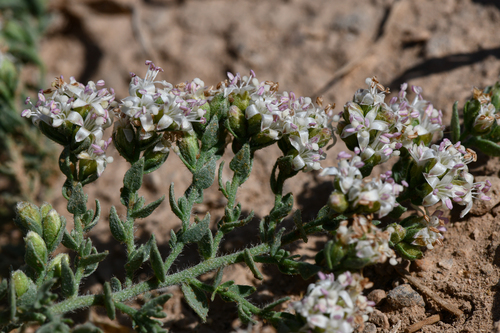
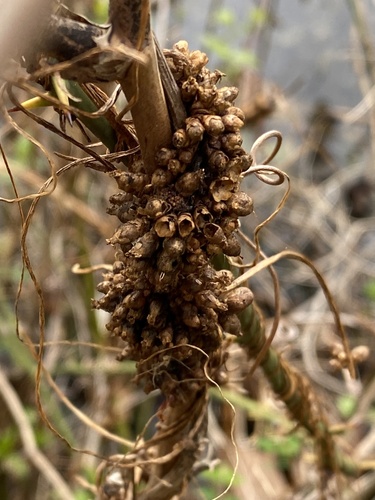
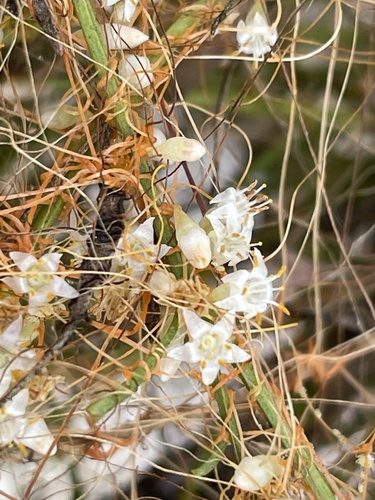
Cuscuta californica Choisy is a parasitic vine that looks like a tangle of yellow-orange straw wrapped tightly around its host plant. Almost all of its structure is stem; its leaves are reduced to small scales on the stem surface, as they do not need to carry out photosynthesis when the dodder obtains all its nutrients from its host. It produces tiny white flowers only about 3 to 5 millimeters wide, and spherical or ovate fruits that measure 1.5 to 2.2 millimeters wide. Flower characteristics can be used to help identify this dodder species: for C. californica, the calyx is between three-quarters the length of the corolla and equal to the corolla length. The lobes of the bell-shaped corolla are equal to or longer than the corolla tube, and the filaments are 0.6 to 1.1 millimeters long. This species occurs across the western United States and parts of Mexico. In the United States, it can be found in Arizona, California, Nevada, Oregon, Utah, and Washington. In Mexico, it occurs mainly in the northwestern part of the state of Baja California. It parasitizes a wide range of herbs and shrubs, including black sage, buckwheat, and deerweed, and grows in many habitat types: sandy desert areas, chaparral, coastal sage scrub, grasslands, Pinus ponderosa forests, and weedy, partially disturbed areas such as roadsides. In these natural and semi-natural habitats, it is not considered a noxious weed, but it does become problematic when it grows in agricultural fields and nursery crops. A population of this species was also discovered in Flowood, Mississippi on August 12, 2022. While C. californica spends most of its life cycle with no contact with soil, it grows from an ordinary rooted seed. It usually germinates in spring, most often when soil temperatures reach 16°C (60°F). The seed holds very little stored energy, so seedlings must find and parasitize a host within just a few days. After the seedling attaches to its host, the rooted original root dies, and the plant becomes fully dependent on the host for all nutrition. This species flowers from spring through autumn, and produces thousands of seeds in summer and late fall. Approximately 5% of these seeds germinate within one year of being produced, while the remaining seeds can stay dormant for up to 20 years, depending on environmental conditions.