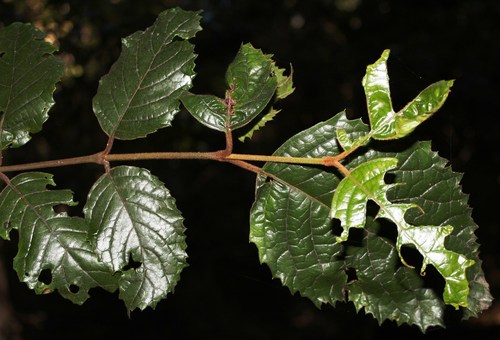
About Curtisia dentata (Burm.fil.) C.A.Sm.
Curtisia dentata (Burm.fil.) C.A.Sm., commonly called the Assegai tree or Cape lancewood, is known as Assegaai in Afrikaans, Umgxina in Xhosa, and Umagunda in Zulu. This flowering tree is native to Southern Africa, and it is the only species in the genus Curtisia. Originally classified as a type of dogwood in the Cornaceae family, this genus is now placed in its own distinct family, Curtisiaceae. The Assegai tree has dark glossy foliage and clusters of pure white berries, making it an increasingly popular ornamental tree for garden planting. Its bark is a very widely used ingredient in traditional African medicine. High demand for its bark has led to overexploitation and population decline of the species in some regions of South Africa, and the tree is protected under South African law. The Assegai tree grows naturally in forests across South Africa and Eswatini, where it occurs from sea level up to 1,800 meters (5,900 feet) in elevation, spanning from Cape Town in the south to Limpopo province in the north. It also grows in Afromontane forest of the Eastern Highlands, along the border between Zimbabwe and Mozambique, as well as on Mount Gorongosa in Mozambique. In deep Afromontane forest, the species grows into a tall tree. On open mountain slopes and coastal areas, it stays a small, bushy tree.

