About Cursorius cursor (Latham, 1787)
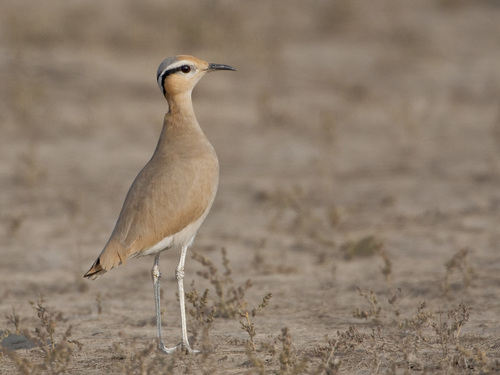
The cream-coloured courser (Cursorius cursor (Latham, 1787)) is reported to reach a total length of 19–21 cm, 21–24 cm, or 24–27 cm across different sources, and has a wingspan of 51–57 cm. It has long legs measuring 7–8 cm, long wings, and slightly downcurved bills. Its body plumage is sandy in colour, fading to whitish on the lower belly. The outer upperwing and underwing are black. The crown is grey, grading to blue-grey on the nape; it also has a black eyestripe and a conspicuous white supercilium, and its legs are pale grey. Juveniles have mottled dark colouration on their upperparts, and a duller head pattern than adult individuals. In flight, this species resembles a pratincole, with relaxed wingbeats, pointed wings and black underwings. This species is found in the Canary Islands, Cape Verde, North Africa and Southwest Asia. It lays two eggs in a ground scrape. Its breeding season typically extends from February to September, but it may also breed in autumn and winter when local conditions, especially rainfall, are favourable. It is partially migratory: northern and northwestern populations winter across the southern edge of the Sahara, in Arabia, and in northwestern India. The species also breeds in the southern desert regions of northwestern India and Pakistan, and has bred occasionally in southern Spain. It is rare north of its core breeding range, but has been recorded as far north as Finland, Norway and Great Britain; it occurs more regularly on Malta, where flocks of up to 30 individuals have been recorded.