About Curruca iberiae (Svensson, 2013)
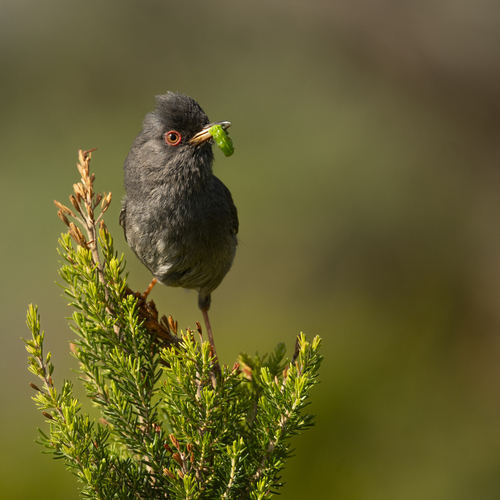
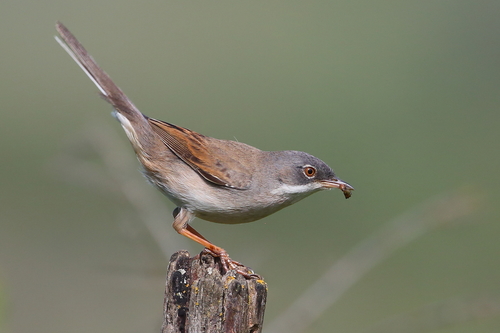
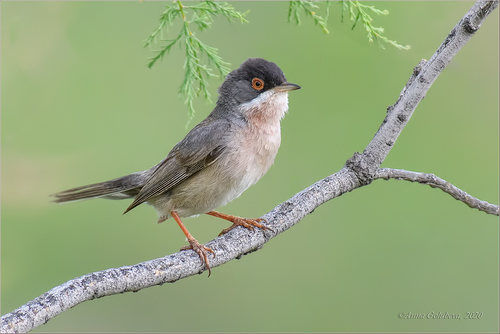
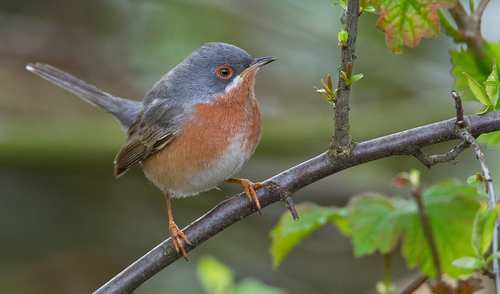
The western subalpine warbler, with the scientific name Curruca iberiae, is a small warbler that belongs to the Sylviidae family. It breeds in the southernmost regions of Europe and north-western Africa. Like most species in the Curruca genus, it has distinct plumage differences between adult males and females. Adult males have a grey back and head, brick-red underparts, and white malar streaks, commonly called "moustaches". Females are mainly brown on their upperparts, with a greyer head, and whitish underparts with a pink flush. The song of the western subalpine warbler is fast and rattling, and similar to the song of the lesser whitethroat. This species is considered related to the Sardinian warbler–Menetries' warbler superspecies. All three of these species have white malar areas, dark upper head coloring in adult males, and naked eye-rings. This group of three species is further related to another superspecies made up of Rüppell's warbler and the Cyprus warbler, which also share the trait of a white malar area with blackish coloring on the upper head, according to research published by Shirihai et al. 2001 and Jønsson & Fjeldså 2006. The formerly broadly defined subalpine warbler was split into two distinct subspecies groups, which some research suggested were diverged enough to qualify as two separate species (Shirihai et al. 2001). The two groups had differing male plumages, distinctive calls, and were allopatric, so further study was called for. In May 2020, the IOC World Bird List split western and eastern subalpine warblers into two distinct species. The western subalpine warbler inhabits dry open country, often on hill slopes, with bushes available for nesting. It builds its nest in low shrub or gorse, and lays between 3 and 5 eggs per clutch. Like most warblers, it is primarily insectivorous, but will also eat berries. This species prefers tall, dense heterogeneous maquis with sparse tree cover in dry Mediterranean areas. It is particularly associated with holm oak (Quercus ilex) maquis, and maquis dominated by strawberry tree (Arbutus) and tree-heath (Erica). It is also frequently found in young cork oak (Quercus suber) forest and in dense, treeless bushy areas. It uses bushy formations dominated by brambles (Rubus fruticosus) along sunny ravines and valley bottoms, and favors intermediate stages of post-wildfire succession. Breeding occurs from late March to late June, and the species is monogamous. Males construct several "cock nests", but both sexes work together to build the actual breeding nest. The breeding nest is a deep, robust cup made from grasses, thin roots and leaves, lined with finer grasses, rootlets and hair. It is placed in low scrub, a bush, or a small tree, approximately 30 to 130 centimeters above the ground. Clutches contain three to five eggs. The diet consists mostly of small insects and their larvae, but outside of the breeding season berries and fruits are also consumed. The western subalpine warbler is a long-distance migrant, and winters in sub-Saharan Africa (Aymí et al. 2015).