About Curio rowleyanus (H.Jacobsen) P.V.Heath
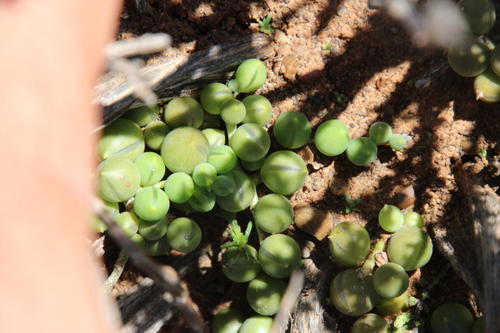
Curio rowleyanus gets its common name from its specialized leaves, which are the size and shape of small peas, reaching around 6 mm (1/4 inch) in diameter. Its trailing stems can grow 60–90 cm (2–3 feet) long. Each leaf has a small tip at its distal end, and a thin dark green strip of tissue on one side called a "window". It blooms in summer, and like all asterids, it produces compound flowers. Trumpet-shaped individual flowers form clusters roughly 13 mm (1/2 inch) across, made up of small white blooms with colorful stamens. Flowers last around one month and are reported to smell like cinnamon and other spices. The unusual spherical shape of this species' leaves is an adaptation to arid environments, enabling water storage while exposing minimal surface area per volume to dry desert air. This greatly reduces evaporation-related water loss compared to the typical dorsi-ventrally flattened leaves of most flowering plants. While this spherical leaf shape minimizes water loss, it also drastically cuts down the surface area available for light absorption and photosynthesis. A narrow, translucent, crescent-shaped band of tissue on the adaxial side of the leaf blade acts as an adaptation to compensate for this reduced light capture. This specialized structure, called an "epidermal window", lets light enter and illuminate the interior of the leaf, effectively increasing the area of leaf tissue available to carry out photosynthesis. This trait is shared by Curio radicans (string of bananas), a close relative of Curio rowleyanus. Similar leaf morphology is seen in species of the genus Fenestraria, as well as in Haworthia cooperi and Frithia pulchra, which grow underground and only expose their leaf tips to absorb light. The plant tissue of C. rowleyanus is somewhat poisonous and should not be eaten. The University of California, Davis rates string of pearls (the common name of this plant) as toxicity classes 2 and 4 for humans. Class 2 indicates minor toxicity: ingesting this plant may cause mild illness such as vomiting or diarrhea. Class 4 indicates dermatitis: contact with the plant's sap may trigger skin irritation or a rash. If consumed by animals, it can similarly cause vomiting, diarrhea, drooling, skin irritation or lethargy. Curio rowleyanus is widely grown as an ornamental plant. It is most often displayed in hanging baskets, where its leaves cascade over the edge of the container. It can be grown indoors or outdoors (in regions where temperatures stay above freezing) and is considered a low maintenance plant. Like most succulents, it needs very infrequent watering (around once per month), a few hours of direct sunlight, and is unaffected by humidity. Good soil drainage is required to prevent root rot, so sandy soil is recommended. This plant can be easily propagated by cutting or pinching off a 10 cm (4 inch) section of healthy stem tip, then lightly covering it with moist potting mix. Roots develop quickly from the points where leaves attach to the stem.