About Curio repens (L.) P.V.Heath
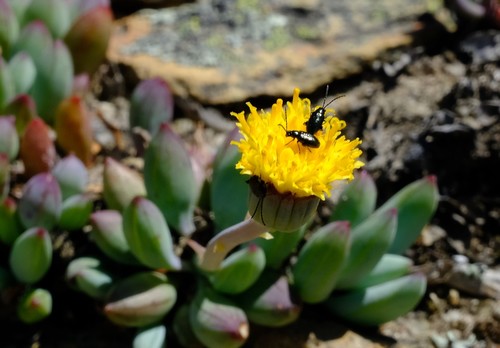
Curio repens (L.) P.V.Heath is a semi-trailing, low-growing dwarf shrub that forms a dense mat, reaching only around 20 cm in height. It has silvery-bluish, finger-like fleshy leaves. It produces small, round, pompom-like flowers that may superficially resemble a virus. Seen from a distance, the flowers appear off-white, but up close their stamens carry yellow and pink tinges. Its flowering season usually occurs between spring and autumn. This species was first formally described as Cacalia repens by Carl Linnaeus in 1767. It can be distinguished from Curio talinoides by its shorter, broader, often boat-shaped leaves. Curio repens is drought tolerant, and it is used as a ground cover, border plant, or for planting in rock gardens. It grows in sandy, dry to slightly moist soils, in full sun or partial shade. It is easily propagated from cuttings. While visually similar to ice plants of the genus Mesembryanthemum, Curio repens typically grows in and among rocky crevices and on exposed ledges of dry, rubble-strewn sandstone slopes, where drainage is fast, and sun exposure and airflow are high. A hybrid of Curio repens and Curio talinoides is known as the cultivar 'Trident Blue'.