About Cupressus macrocarpa Hartw. ex Gordon
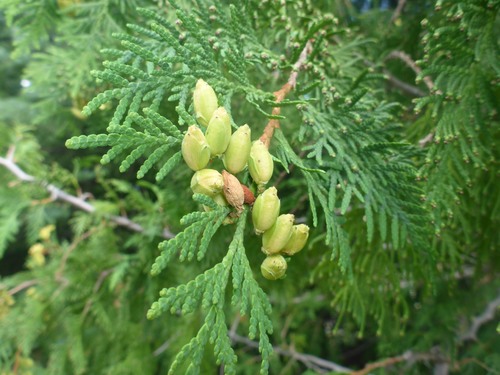
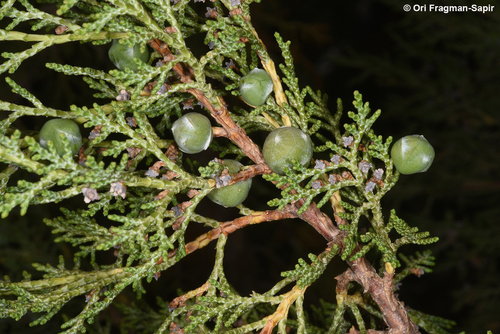
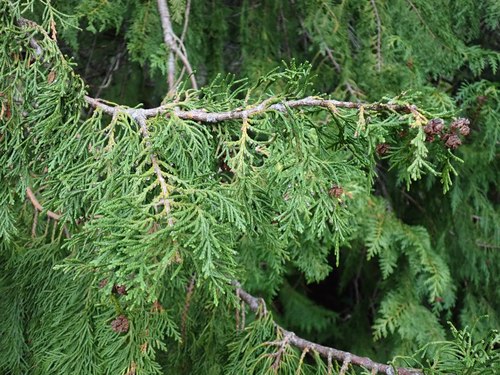
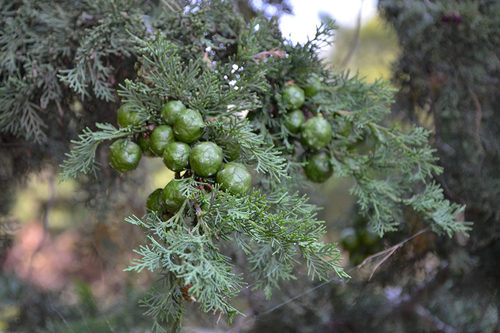
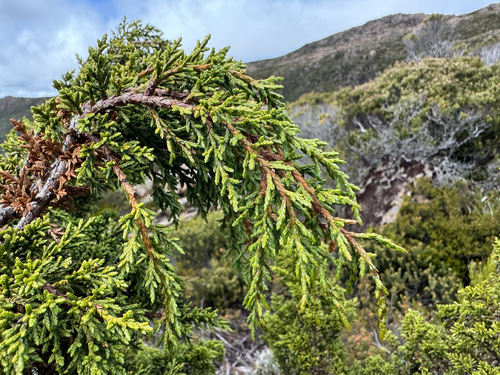
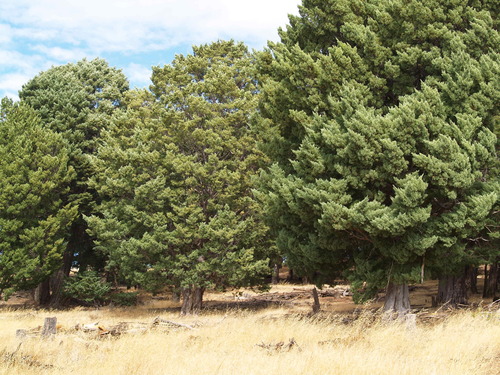
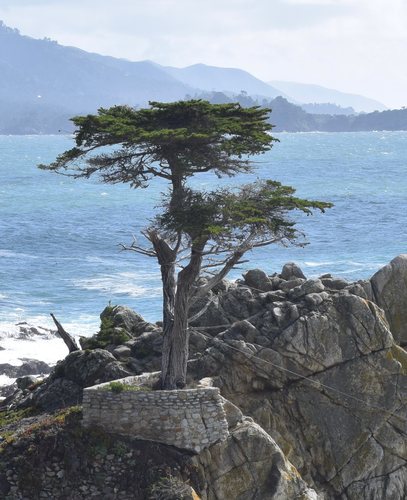
Hesperocyparis macrocarpa (also known by the scientific name Cupressus macrocarpa Hartw. ex Gordon, or commonly as Monterey cypress) is a medium-sized coniferous evergreen tree. Trees growing in its native area often develop an irregular, flat-topped shape from the region’s typical strong winds. When grown in perfect conditions, it can reach up to 40 meters (133 feet) in height, with a trunk diameter up to 2.5 meters (over 8 feet). Its foliage grows in dense, bright green sprays that release a deep lemony aroma when crushed. The leaves are scale-like, 2–5 mm long, and grow on rounded rather than flattened shoots; seedlings up to one year old have needle-like leaves that are 4–8 mm long. Seed cones of this species are globose to oblong, 20–40 mm long, and have 6–14 scales. They start out green, and mature to brown around 20–24 months after pollination. Pollen cones are 3–5 mm long, and release pollen in late winter or early spring. Its specific epithet macrocarpa, which comes from Greek, translates to “with large fruit”. Due to the large trunk size some trees grow to, people have hypothesized that individual H. macrocarpa trees could live up to 2,000 years. However, the longest verified lifespan based on physical evidence is only 284 years. Prominent Californian botanist Willis Linn Jepson wrote that claims of this species living 1,000 to 2,000 years in seaside literature are not supported by any actual data, and likely exist only to satisfy popular interest in extraordinary superlatives. Few trees survive beyond 100 years in its native range. In contrast, many of the earliest plantings of this species introduced to New Zealand around 1860 are still alive today; the main cause of death for these cultivated specimens is felling. One surviving example is the 160-year-old St. Barnabas Church tree in Stoke, Nelson, New Zealand. The species has only two protected native cypress forest stands, located within Point Lobos State Natural Reserve and Del Monte Forest. Its native natural habitat has cool, moist summers, and trees here are frequently shrouded in sea fog. This species has been widely planted outside of its native range, especially along the coasts of California and Oregon. In Europe, it grows in Great Britain (including the Isle of Man and the Channel Islands), France, Ireland, Greece, Italy and Portugal. In New Zealand, planted specimens have naturalized, and the local conditions are more favorable for the species than its native range. It has also been grown experimentally as a timber crop in Kenya. The tree has been successfully planted in Sri Lanka, where a 130-year-old specimen is displayed at the Hakgala Botanical Garden in Nuwara Eliya. It is grown in South Africa as well; a copse was planted there to honor South African infantrymen who died fighting for the Allied cause in Italy and North Africa during World War II. Like native trees in California, the Cape trees are gnarled and shaped by wind. Monterey Cypress has also been introduced to the Falkland Islands, where it forms a small forest at Hill Cove and another stand at Carcass Island. Monterey cypress is widely cultivated outside its native range, both along other parts of the California coast and in other areas with similar oceanic climates that have cool summers and mild winters. It was cultivated in the United Kingdom very early; in 1846, Karl Hartweg sent seeds to the Royal Horticultural Society along with a report on his travels in California. It is a popular tree for private gardens and public landscapes in California, and it is planted so widely in Golden Gate Park that the silhouette of the tree is sometimes used as a symbol of the park. When planted in regions with hot summers, such as inland California away from the coastal fog belt, Monterey cypress is highly susceptible to cypress canker, a disease caused by the fungus Seiridium cardinale, and rarely survives more than a few years. This disease is not an issue in regions with cool summers. The foliage is slightly toxic to livestock, and can cause miscarriages in cattle. Sawn logs are used by many crafters, some boat builders, and small manufacturers, as a structural material for furniture and as decorative wood, due to its attractive fine coloring. The wood must be carefully preserved to prevent splitting. It is also a fast-burning, hot-burning firewood, but it produces many sparks so it is not suitable for use in open fires.