About Cupressus goveniana Gordon
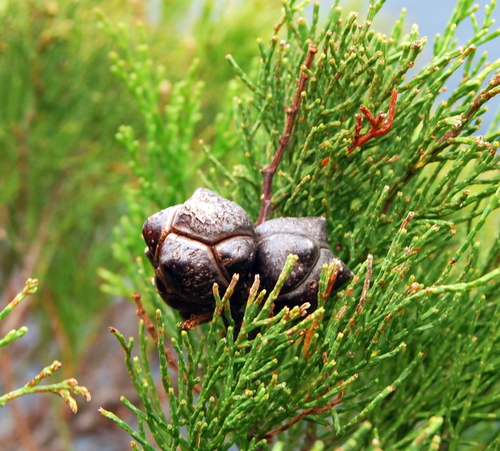
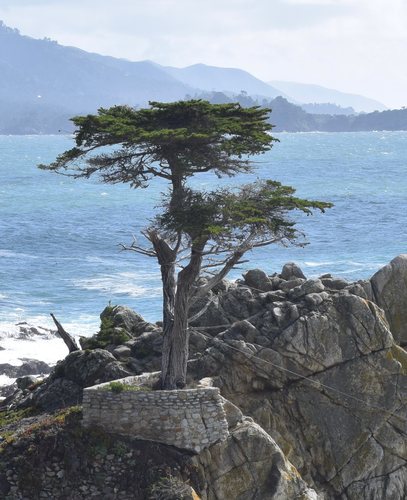
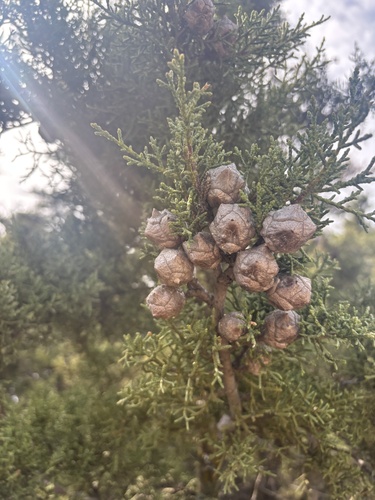
Hesperocyparis goveniana (scientific name basionym: Cupressus goveniana Gordon) is an evergreen tree with a crown shape ranging from conic to ovoid-conic. Its mature size is highly variable, ranging from under 1 m (3 ft 3 in) tall on poor sites to 50 m (160 ft) tall under ideal growing conditions. Its foliage grows in dense sprays, and ranges in color from dark green to somewhat yellow-green. Its leaves are scale-like, 2–5 mm (0.08–0.20 in) long, and grow on rounded rather than flattened shoots. The seed cones of this species are globose to oblong, 11–22 mm (0.43–0.87 in) long, and have 6 to 10 scales. They start out green, and mature to brown or gray-brown roughly 20–24 months after pollination. These seed cones stay closed for many years, and only open after the parent tree is killed by wildfire. This opening allows seeds to colonize the bare ground left exposed by the fire. Male cones are 3–5 mm (0.12–0.20 in) long, and release pollen in February or March. The cones of H. goveniana are typically smaller than the cones of H. macrocarpa. This tree is endemic to the Monterey Peninsula in coastal Monterey County, on the Central Coast of California, Western United States. It grows in small, scattered populations, and does not form large continuous forests of its own species. It occurs alongside Hesperocyparis macrocarpa (Monterey cypress) in the two naturally occurring groves of Monterey cypress in Monterey County. It has been introduced outside of California to Robinson Crusoe Island in Chile. This species is classified as an endangered species on the IUCN Red List.