About Cupiennius salei (Keyserling, 1877)
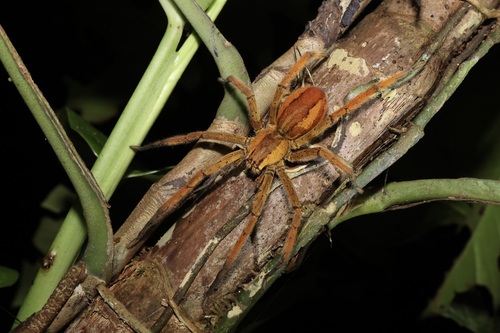
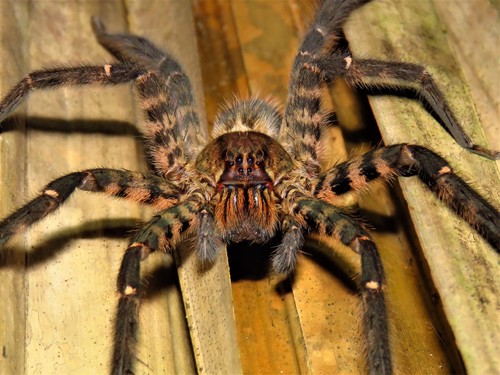
Cupiennius salei (Keyserling, 1877) is a large spider species with clear sexual dimorphism. Females are larger than males, reaching up to 3.5 cm in body length with a 10 cm leg span. Their dorsal body is chocolate-brown, with small lighter spots on the abdomen and many darker longitudinal stripes, most prominent on the carapace. The ventral side is red-orange, with a thick black central region under the abdomen. Males reach up to 2.5 cm in body length, have very long, thin legs, are much lighter in color than females, and are identifiable by their conspicuous palpal bulbs. This species is naturally found across northern Central America and Mexico; more specifically, it occurs naturally in southeastern Mexico, Guatemala, Belize, Honduras, Nicaragua, and possibly extends into northwestern Costa Rica. Other species in the Cupiennius genus are found across various parts of Central America and South America. C. salei has been introduced to other parts of the world both accidentally—for example, through accidental imports from banana plantations in the early 20th century—and deliberately, as a laboratory model organism or an exotic pet. There are currently no records of established wild populations of this species outside its native range of Mexico and Central America. C. salei can occupy a wide range of natural habitats, but is primarily found in moister broadleaf subtropical and tropical forests. It can also live near human settlements in disturbed areas, where introduced plants like bananas provide ideal shelter. In general, C. salei is largely arboreal, living in trees and bushes, and prefers plants with broad flat leaves and wide joints that offer shelter. Banana plants and many bromeliads provide particularly ideal refuges; the spiders often shelter at the base of these plants, where pooled water offers additional protection. While they often stay inactive for long periods resting on the surfaces of broad leaves, they can run quickly when provoked, either to catch prey or escape threats. C. salei is a nocturnal, sit-and-wait ambush predator that follows strong circadian rhythmicity. It hides during the day, mostly under leaves, and emerges at dusk. When light intensity drops to around 15 lux at sunset, the spider leaves its refuge but usually stays nearby. It remains motionless there for roughly 30 minutes until it becomes fully dark, with light intensity falling below 0.1 lux, then moves to the surface of a leaf to wait in ambush for prey, occasionally walking briefly across the leaf. The species’ activity peaks during the first three hours of the night, and individuals retreat back to their refuge after six to seven hours of activity. Under laboratory conditions, female C. salei produce cocoons every three to four weeks, each holding up to 1,500 embryos. Each embryo is typically 1.3 mm in diameter. The full life cycle from fertilized egg to mature adult takes between 9 and 12 months. After hatching from the cocoon, larvae begin feeding; they are generally first fed fruit flies, then switched to larger cricket prey as they grow. Individuals become reproductively mature after their final molt. During courtship, C. salei communicate via sex pheromones. Females, which are usually solitary, release pheromones onto silk threads strung along trees to attract males. When a male detects the pheromone, he produces oscillatory movements that create vibrations on leaves, with an average frequency of 76 Hz. The female responds with a counter vibration, which guides the receptive male to her exact location. The female pheromone has been identified as (S)-1,1'-dimethyl citrate. Males’ pheromone sensory cells are located in tip pore sensilla, and respond to contact with either female silk or the synthetic form of the pheromone. C. salei has one pair of principal eyes and three pairs of secondary eyes located on the prosoma, the anterior end of the head. This species is color blind. Adapted to a nocturnal lifestyle, it has reduced visual ability, and relies primarily on tactile sensation to detect movements or vibrations in its environment.