About Cuphophyllus pratensis (Pers.) Bon
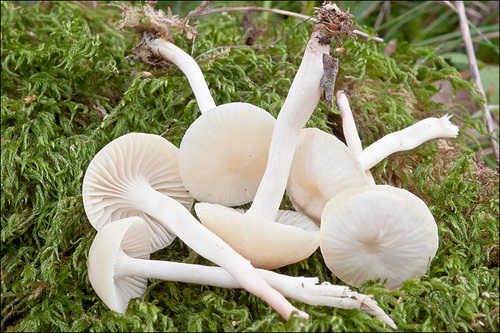
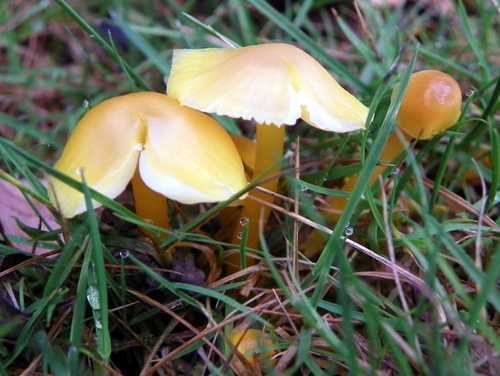
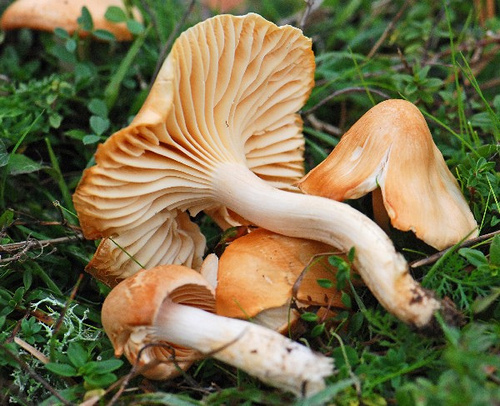
Cuphophyllus pratensis (Pers.) Bon, commonly called the meadow waxcap, produces agaricoid basidiocarps. When young, the cap is convex; as it expands it becomes flat, umbonate, or slightly depressed, and can reach up to 6 centimetres (2+1⁄4 inches) across. The cap surface is smooth, dry, and ranges in colour from pale salmon to orange-buff. The lamellae, or gills, are waxy, pale, and decurrent, meaning they are widely attached to and run down the length of the stipe. The stipe, or stem, can be up to 7 cm (2+3⁄4 in) long, is smooth, is either cylindrical or tapers toward the base, and is creamy in colour. The flesh is whitish, with a mild smell and taste, though occasionally the smell and taste can be unpleasant. The spore print is white. Under a microscope, the spores are smooth, inamyloid, and ellipsoid, measuring approximately 5.5 to 6.5 by 4.0 to 5.0 micrometres. This species has a widespread distribution, occurring primarily in temperate zones. It has been recorded in Europe, North Africa, North and South America, northern Asia, Australia, and New Zealand. Like other waxcaps, in Europe it grows in old, unimproved, short-sward grassland such as pastures and lawns, but grows in woodland in other regions. Recent research indicates that waxcaps are neither mycorrhizal nor saprotrophic, and may be associated with mosses.