About Cupaniopsis serrata (F.Muell.) Radlk.
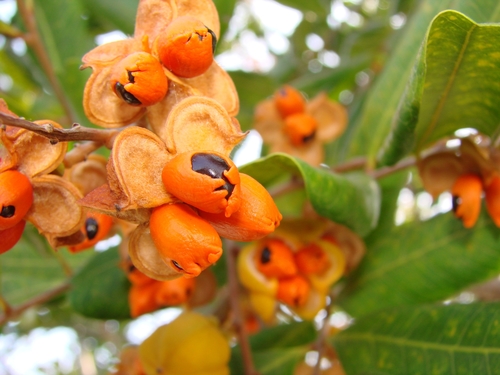
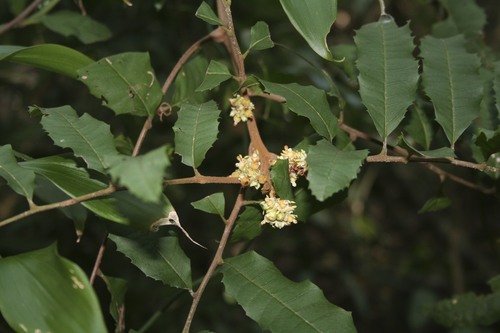
Cupaniopsis serrata, commonly known as smooth tuckeroo, is a shrub or small tree that typically reaches a height of 4 to 25 meters (13 to 82 feet), with a maximum diameter at breast height of 30 centimeters (12 inches). Its branches, petioles, leaf rhachises, and peduncles are covered in soft, rusty-brown hairs, and both branchlets and petioles have lenticels. The leaves are paripinnate, bearing 6 to 12 oblong to egg-shaped leaflets. Each leaflet is 60 to 125 millimeters (2.4 to 4.9 inches) long and up to 25 millimeters (0.98 inches) wide, with a pointed tip. The leaf rhachis itself measures 45 to 145 millimeters (1.8 to 5.7 inches) long. Flowers are sessile, arranged in racemes that are 10 to 65 millimeters (0.39 to 2.56 inches) long. The sepal lobes grow up to 5 millimeters (0.20 inches) long and are covered in soft hairs, while the petals are white, egg-shaped, and 2.5 millimeters (0.098 inches) long. The fruit is a sessile, more or less spherical drupe, 12 to 16 millimeters (0.47 to 0.63 inches) long and 25 to 28 millimeters (0.98 to 1.10 inches) wide, covered in velvety hairs. The fruit holds a seed that is nearly fully enclosed by an orange aril. This species grows on rocky hillsides and in rainforest, occurring from near Gympie in south-eastern Queensland to near the Tweed River in northern New South Wales.