About Cupaniopsis flagelliformis (F.M.Bailey) Radlk.
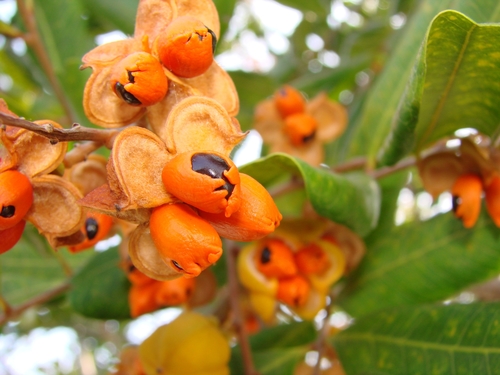
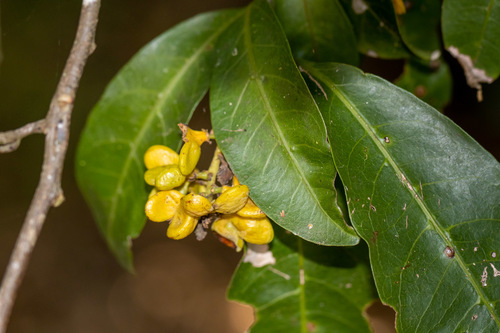
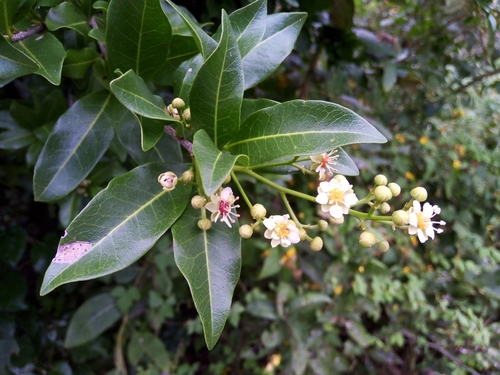
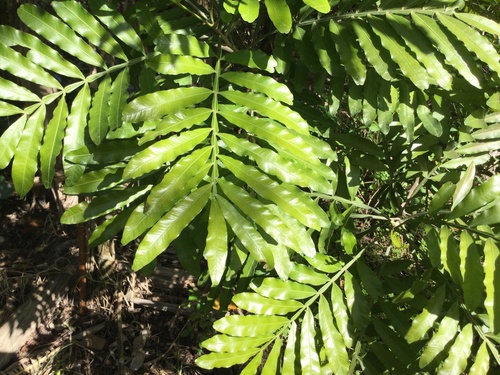
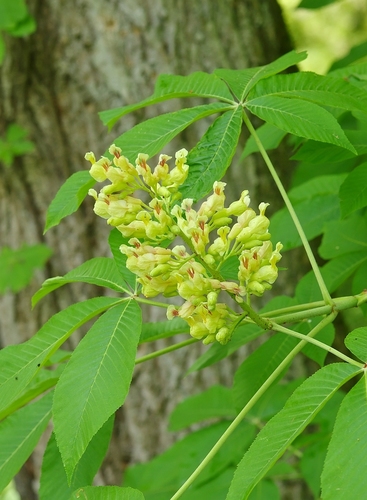
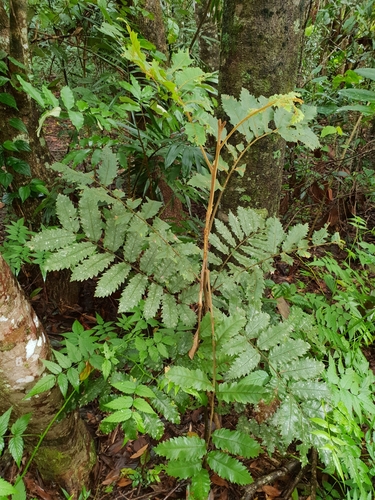
Cupaniopsis flagelliformis (F.M.Bailey) Radlk., commonly called brown tuckeroo, is a small tree that can reach up to 25 meters (82 feet) in height, with an open, spreading crown. Its new growth is densely hairy, and its twigs are puberulous. The leaves are alternate and compound, growing up to 30 centimeters (12 inches) long, and carry 10 to 20 toothed leaflets. Most leaflets measure around 10 centimeters (3.9 inches) long by 4 centimeters (1.6 inches) wide, though they can grow much larger. Small flowers are borne on pendant spikes up to 55 centimeters (22 inches) long, which form either at the end of branches or in leaf axils. The sepals are much larger than the petals, and are red or pink; the petals are white or pink, and the whole flower is around 9 millimeters (0.4 inches) in diameter. The fruit is a red, pink, or yellow capsule, measuring roughly 22 millimeters (0.9 inches) long by 26 millimeters (1.0 inch) wide. The fruit capsule is densely hairy on the outside and silky hairy internally, and is divided into three segments. Each segment holds a single brown or black seed, which is mostly enclosed by an orange-yellow aril. Brown tuckeroo grows as an understorey tree in tropical and subtropical rainforest and monsoon forest, at altitudes ranging from sea level up to around 1,100 meters (3,600 feet). It occurs in four separate disjunct populations, ranging from the northern tip of Cape York Peninsula to northeastern New South Wales. The first population is located on Prince of Wales Island and the northern tip of Cape York, north of Bamaga. The second population occurs in and around Kutini-Payamu National Park, roughly between the Olive River and Lockhart River. The third and largest population is located around 400 kilometers (250 miles) south of Lockhart River, extending from near Cape Tribulation to the area around Ingham. The fourth, most isolated population lies around 1,300 kilometers (810 miles) further south, in far southeast Queensland and far northeast New South Wales. Flowering takes place from July to January, and fruit ripens from September to July. This species is growing in popularity as a cultivated plant, because it is easy to grow and has attractive foliage, flowers, and fruit. Around 20 brown tuckeroo trees have been planted as street trees in the city of Cairns, and Cairns Regional Council provides the species for approved revegetation projects in the Cairns area.