About Cunila origanoides (L.) Britton
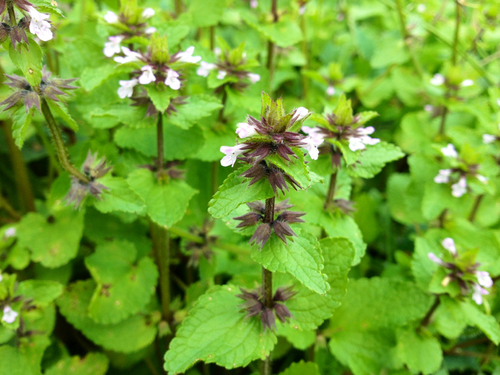
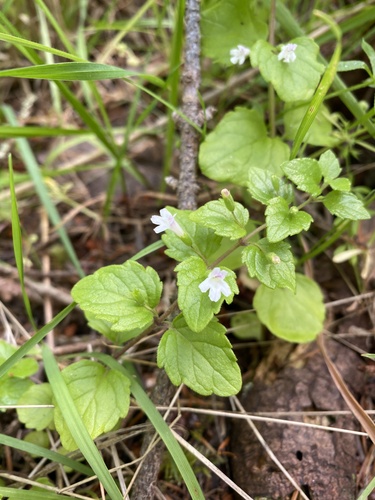
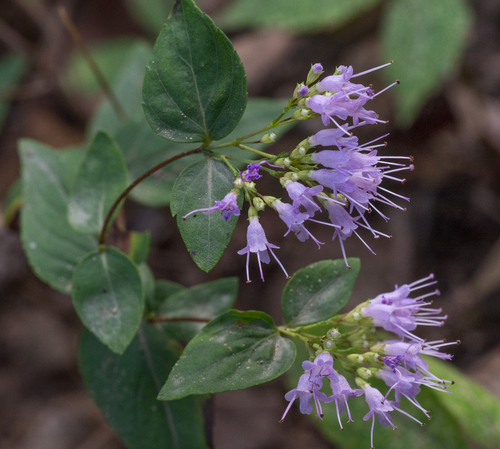
Cunila origanoides (L.) Britton is a low, shrub-like plant with square, stiff, branching stems that reach 15–46 cm (0.5–1.5 ft) in height. Its stems are purple in spring, turn red when the plant blooms, and become brown and woody by fall. Its leaves are arranged oppositely, growing 2–4 cm (0.7–1.5 in) long. They are either sessile or have very short petioles, and can be lanceolate, ovate, or ovate-cordate with finely toothed margins. When crushed, the leaves release a strong mint aroma. Small purple or lavender flowers, reaching up to 0.8 cm (0.3 in) in length, grow in cyme clusters at the ends of branches. The flowers are tubular, with 4 flared lobes. The 2 stamens and style are twice as long as the corolla, and extend noticeably outward from the flower. This species is native to the United States, where its range extends to Texas in the west and south, to Illinois and New York in the north, and to North Carolina in the east. It grows in dry locations including upland rocky woodlands, rocky slopes and ridges, and semi-shaded areas on sandstone cliffs. Cunila origanoides blooms in late summer and fall; its flowers attract butterflies, bees, and other insects. It is a known host plant for the moth Stephensia cunilae, and is one of the few confirmed plant species that produces frost flowers. Fresh or dried leaves of Cunila origanoides have been used to make tea with a pleasant mint flavor. This tea has also been used to treat headaches, colds, and fevers, and to induce menstruation and perspiration. Cunila oil, an essential oil obtained from the plant, can be used as an antiseptic, aromatic, and stimulant.