About Cullen australasicum (Schltdl.) J.W.Grimes
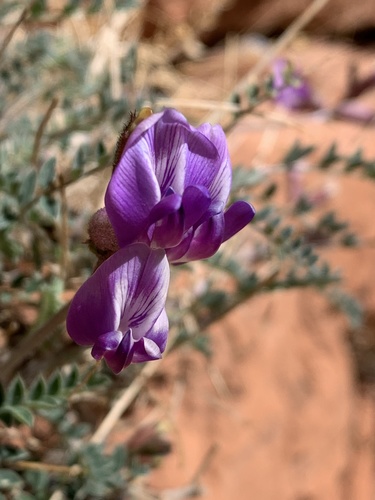
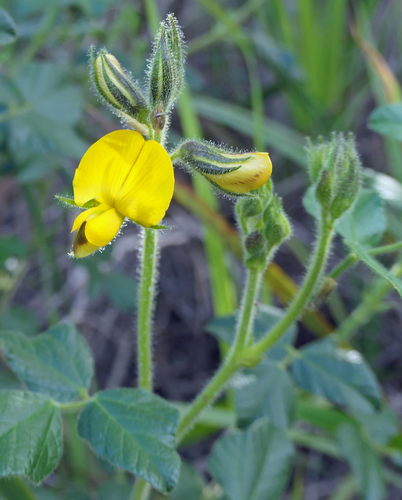
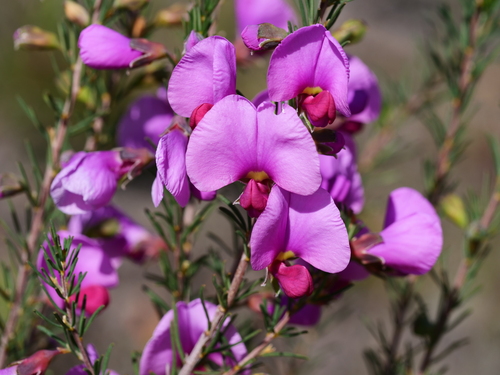
Cullen australasicum can reach 2.5 metres in height and up to 1.5 metres in width. Its stems become woody at the base. This species has rough, toothed trifoliate leaves, with leaflets that are mostly 1 to 5 centimetres long and 1 to 3 centimetres wide. Small lilac pea-flowers grow in groups of three, held on long spikes that sit well above the leaves. Its seeds are light brown and egg-shaped. Cullen australasicum predominantly grows in the arid zone of Australia, in low rainfall environments, and can be found across all mainland Australian states and territories. It favours habitats including rocky gorges, woodland, grassland, dry creek lines and depressions. It is classified as critically endangered in Victoria. Ecologically, Cullen australasicum is a larval food plant for the Chequered swallowtail butterfly, Long-tailed Pea-blue, Common Grass-blue, Cotton Bollworm and Native Budworm. It is also a common food source for kangaroos. In cultivation, some stockists in South Australia sell Cullen australasicum for home garden use. Light pruning is recommended to keep the plant compact, and to avoid the straggly growth habit that is common in naturally occurring plants. No cultivars of this species are currently available.