About Culicicapa ceylonensis (Swainson, 1820)
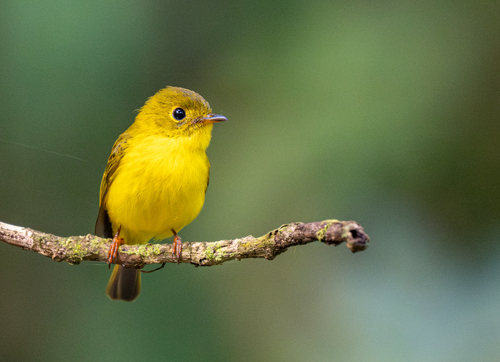
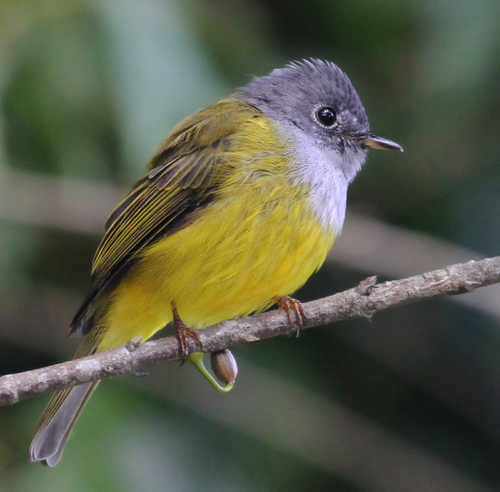
The grey-headed canary-flycatcher, with the scientific name Culicicapa ceylonensis (Swainson, 1820), measures around 12–13 cm (4.7–5.1 in) in length. It has a squarish grey head, a canary yellow belly, and yellowish-green upperparts. Individuals forage actively in the manner of flycatchers, and perch with a very upright posture. Male and female plumage is indistinguishable. This species has a very flat bill, which led to its earlier placement in the genus Platyrhynchus; when viewed from above, the bill looks like an equilateral triangle, and is fringed with long rictal bristles. Across the species’ entire range, different populations vary in color shade, and differ slightly in body size. Several distinct populations have been formally designated as subspecies. The nominate subspecies breeds in the hills of peninsular India, including the Western Ghats, Nilgiris, central India and the Eastern Ghats (Lammasingi), as well as in Sri Lanka. This nominate form has darker coloration. Subspecies calochrysea, first described by Harry Oberholser in 1923, breeds along the Himalayas east to Myanmar and Thailand, and winters across southern India. Subspecies antioxantha, also described by Oberholser, has a breeding range extending from southern Burma and Thailand through Malaysia to Java and Bali. The island population sejuncta, described by Ernst Hartert in 1897, occurs on Sumbawa, Flores and possibly on Lombok. Subspecies connectens, described by Bernhard Rensch in 1931, is restricted to the island of Sumba. The grey-headed canary-flycatcher was previously classified as an Old World flycatcher, despite its unusual crest, coloration, and vocal traits. Molecular phylogeny studies have since shown this species is quite distinct from Old World flycatchers, and it is now placed in the family Stenostiridae, which is closely related to tits and penduline-tits. This species breeds in upland to montane oak (Quercus) forests and other broadleaved forests, as well as similar wooded areas, across temperate to tropical southern Asia, ranging from Pakistan, Central India, Bangladesh and Sri Lanka east to Indonesia and southern China. Many populations are resident, but some Himalayan birds are partial migrants that spend the winter in peninsular India, and may sometimes occur even in arid habitats. Other populations may make altitudinal movements, but in parts of the eastern Himalayas such as Bhutan, the species has been found year-round, and can be found up to and above 2,000 m above sea level. During the non-breeding season (September to March in India), they occur in the plains and at lower elevations, where they prefer well-wooded areas of relatively mature secondary forests, abandoned plantations and overgrown gardens, usually close to water and streams including wooded gorges. They are very active and noisy throughout the day, foraging at all levels of the forest. The grey-headed canary-flycatcher is an insectivore. Like flycatchers, it makes sallies from a low perch under a tree’s canopy to catch aerial insects. Pairs may forage together, and individuals will often join mixed-species foraging flocks. They breed in summer: from April to June in India, and possibly later in western China. The nest, built only by the female, is an unlined cup bound together with cobwebs, and is often attached to and covered by moss. The nest is positioned against the mossy trunk of a tree, built on rocks, or placed on a ledge in a mud bank. A typical clutch contains three or four eggs. Hodgson's hawk-cuckoo has been observed parasitizing the brood of this species in northern Borneo.