About Culex pipiens Linnaeus, 1758
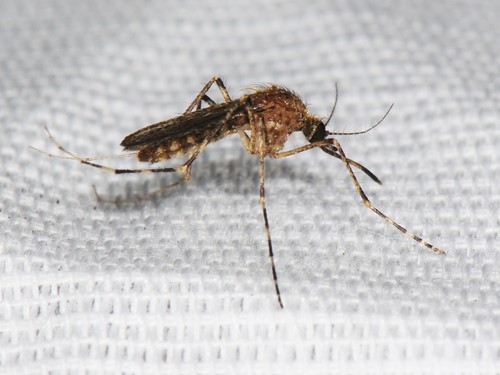
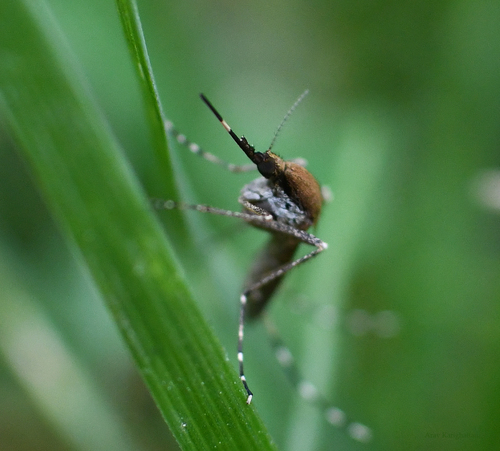
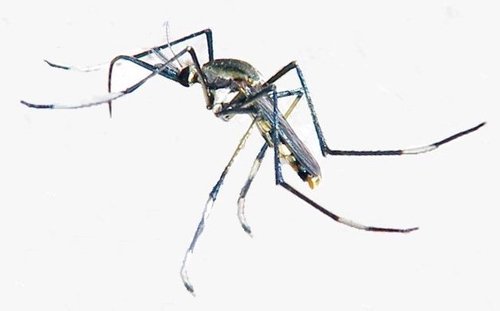
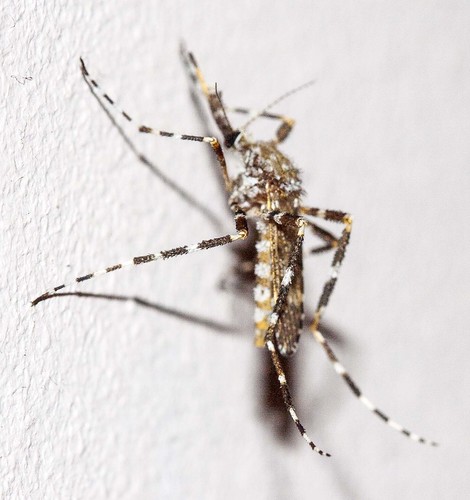
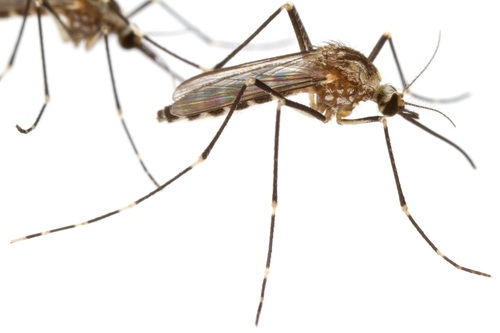
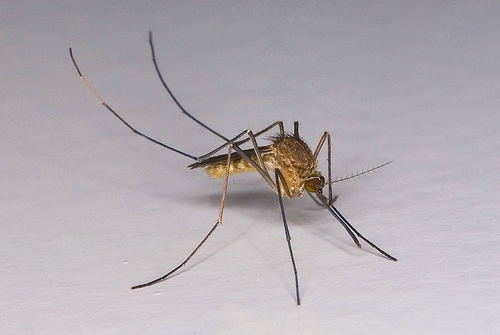
Culex pipiens Linnaeus, 1758 individuals are generally pale to light brown or grey-brown, with lighter stripes or bands across the abdomen. Their body length ranges from three to seven millimeters. They have an elongated sucking mouthpart called a proboscis; both the proboscis and wings are brown, matching the rest of the body.
Culex pipiens reproduce in water, specifically flood-prone areas and standing water. Additional breeding sites include natural marshes, cesspits, gutters, and other unmaintained artificial water structures. Organic material must be present in breeding grounds for larval development to occur. All mosquito species have aquatic larvae, and as Daniel Markowski of Vector Disease Control International states, Culex pipiens larvae thrive specifically in stagnant water with high levels of organic material pollution.
A 1973 study by Skierska examined how larval density affects offspring survival success. The study found the highest larval survival occurs at a density between 20 and 50 larvae per breeding site. Within this density range, larval development is also faster than at densities above this range. Higher larval densities also reduce the number of eggs produced by surviving females from the original population.
Culex pipiens is distributed across urban and suburban temperate and tropical regions worldwide, and is common on most continents, including North America, South America, Europe, parts of Asia, and Northern Africa.
Most members of the Culex genus, including many other mosquito species, thrive in mostly wet, humid, temperate climates. In California populations, most female C. pipiens do not enter reproductive diapause during winter, unlike other related mosquito species such as C. stigmatosoma or C. tarsalis. Instead, most overwinter in a state of host-seeking arrest. They survive winter in sheltered locations protected from weather, such as basements, sheds, and sometimes caves. Overwintering behavior varies based on location, temperature, and daily photoperiod (the amount of daylight received per day). Both parous and nulliparous females may overwinter together.
Ecologically, Culex pipiens acts as a pollinator for Silene otites, tansy (Tanacetum vulgare), and Achillea millefolium. This species can see in the ultraviolet range, and uses UV cues from flowers to locate them. Laboratory studies have tested C. pipiens survival across varying pH levels, organic material levels, temperature, and salinity levels. These studies confirm that C. pipiens can survive extreme values for all these metrics, demonstrating its eurytopic nature — the ability to tolerate a wide range of habitat and ecological conditions. According to V. V. Tarabrin and M. M. Orlov, development from larva to adult imago takes 20 to 25 days. The optimal conditions for reproduction are an air temperature of 26 to 29 °C, relative humidity of approximately 80%, and a water temperature of at least 16 to 17 °C.
Culex pipiens feeds on a variety of food sources. Sugar is an important energy source that provides the same amount of energy as blood for this species. Both males and females get sugar from plant sugar sources, floral nectar, and honeydew, which they locate using olfactory and visual cues. Females differ from males: they consume both blood and sugar for energy, while males rely solely on sugar sources. Females take blood from hosts including birds, humans, and cattle. Finding a blood host requires a complex set of behavioral responses that rely on C. pipiens sensory mechanisms to locate hosts. Females have 1,300 sensory organs, while males have 1,350. A 2018 study by Garvin et al. found that C. pipiens is more attracted to adult birds than nestlings, by distinguishing between the uropygial gland secretions of birds of different ages, tested on Passer domesticus.
C. pipiens feeding activity follows four distinct stages: activation, orientation, landing, and probing. Locating a host relies on both visual and chemical environmental cues to allow C. pipiens to detect the host's position.