About Culcita novaeguineae Müller & Troschel, 1842
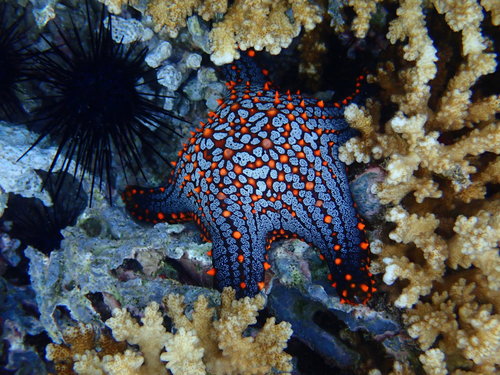
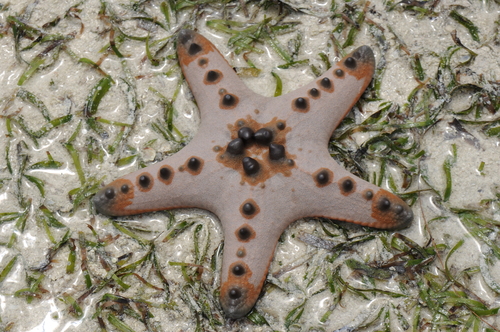
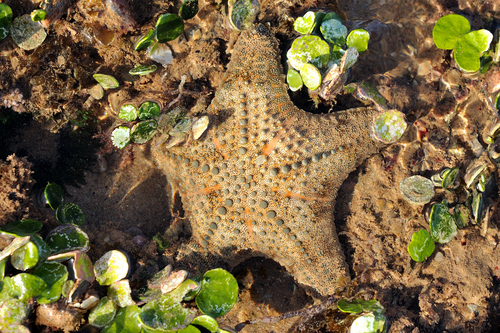
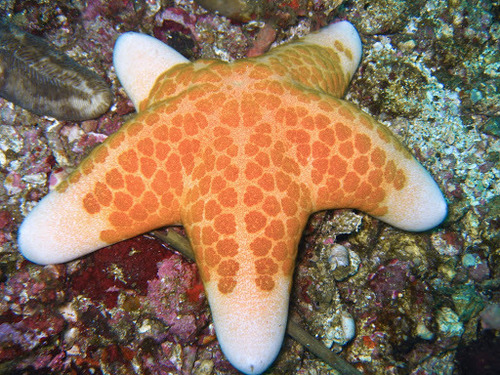
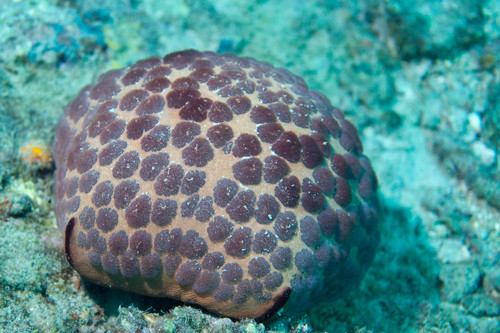
Mature Culcita novaeguineae are pentagonal to subglobose in shape, with an inflated appearance and greatly shortened arms. This species can reach a diameter of 30 cm (12 in). Rows of tube feet are located on its underside, and it has a central mouth. Its coloration is very variable, including mottled patterns of darker and lighter shades of fawn, brown, orange, yellow and green. Its armoured body wall is formed from calcareous ossicles, which are internally supported by pillars that buttress the ambulacra. The armouring has pits that allow tube feet to be retracted into them, and the body cavity is filled with water. The dorsal surface may be covered in small conical tubercles, both inside and outside papular areas. Young small cushion stars of this species look very different from mature individuals: they are star-shaped with five short, broad arms and a low profile. As they grow, the inter-arm areas fill in and expand relative to the tube-foot areas, and the arms become shorter in proportion to the disc, which inflates and grows more massive. Culcita novaeguineae occurs in the Indian and Pacific Oceans, with a range that extends from Madagascar and the Seychelles to the Philippines, New Guinea (the location the species is named for), Australia and Hawaii. A variety of other organisms live in or on Culcita novaeguineae. The small shrimp Periclimenes soror is a commensal that hides under this cushion star. Three species of copepod—Astroxynus culcitae, Stellicola oreastriphilus and Stellicola parvulipes—live parasitically on the external surface of the cushion star. The star pearlfish (Carapus mourlani) sometimes acts as a commensal that lives inside the cushion star, entering the large body cavity through an ambulacral groove and emerging periodically to feed.