About Cucurbita foetidissima Kunth
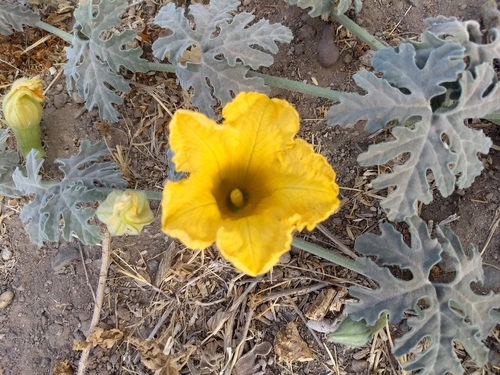
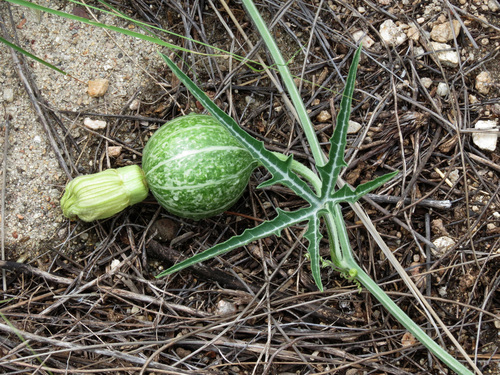
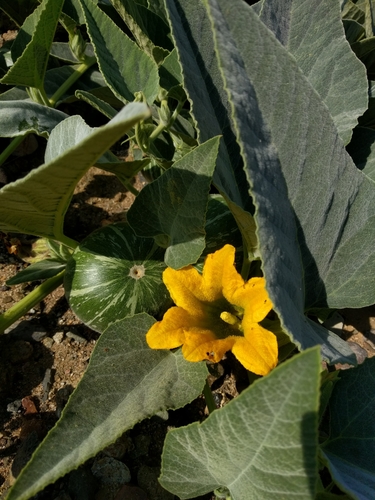
Cucurbita foetidissima Kunth, commonly called buffalo gourd, is a perennial plant with specific cultivation requirements and morphological traits. It needs very little water, and grows best in semiarid and arid environments. Warm weather is required throughout its five to eight-month vegetation period. It is well adapted to marginal agricultural lands, and prefers well-drained sandy loam soils. Germination occurs when temperatures are between 15 °C and 37 °C, with an optimum germination temperature of 25 °C. The maximum soil depth for successful germination is 12 cm. Germination is possible across a pH range from 2.2, which gives a 15% germination rate, up to pH 8, which gives a 90% germination rate. This species can be propagated asexually from nodal roots. Buffalo gourd leaves are typically entire and heart-shaped, with a base width of 10–13 cm (4–5 in) and a length of 20–25 cm (8–10 in). Flowers grow singly at vine nodes after a certain amount of annual vegetative growth is complete. Its fruit measures 7–10 cm (3–4 in) in diameter, and weighs between 120 g and 150 g. Each fruit contains 292 to 315 seeds. The seeds themselves are 12 mm (0.5 in) long and 7 mm (0.3 in) wide, and roughly 4 g per 100 seeds; the seed coat makes up approximately 30% of a seed’s total weight. Seeds often remain viable for months or even years when kept inside an undamaged gourd. One hectare of buffalo gourd plants can produce 2.5 tons of seed. The plant forms a fleshy tap root that acts as a storage structure and overwintering organ. The central tap root can weigh up to 72 kg (159 lb). A cultivated four-year-old root can reach a fresh weight of 45 kg (99 lb) and a length of 2.5 m (8.2 ft). Cucurbita foetidissima is native to North America. In the United States, it occurs in the central and southwestern region, specifically in Arizona, Arkansas, southern California, Colorado, Kansas, Missouri, southern Nebraska, southern Nevada, New Mexico, Oklahoma, Texas, and southern Utah. In Mexico, it is found in Aguascalientes, Chihuahua, Coahuila, Guanajuato, Guerrero, Hidalgo, northern Jalisco, Mexico, Nuevo León, Querétaro, San Luis Potosí, Sonora, Tamaulipas, and Zacatecas. Buffalo gourd has potential as a crop adapted to arid and semiarid lands, and is also used as a durable groundcover to conceal and protect banks from erosion. As a food source, fresh young buffalo gourd fruits can be eaten like squash. Mature fruit is not edible, due to the presence of bitter compounds. Seeds can be eaten after preparation by roasting or boiling. The extractable oil content of whole seeds ranges from 24.3% to 50%. Linoleic acid, an essential polyunsaturated fatty acid, makes up 38% to 65% of this oil. Analysis of buffalo gourd oil shows it is similar to other common edible oils. Whole buffalo gourd seeds contain approximately 31% crude protein, which can be used for human consumption and animal feed. Starches are primarily located in the tap root, which develops after the plant’s first year of growth. The starch content of dried tap root ranges from 47.5% to 56%. Fresh leaves or entire buffalo gourd plants can be used as animal food. The Zuni people use a medicinal poultice made from powdered seeds, flowers, and saliva to treat swellings. Cucurbita foetidissima contains saponin that can be extracted from the fruit and root. In Cahuilla Native American culture, the fruit and other plant parts have been used for their saponin content as laundry soap, by rubbing plant parts against dirty clothing. However, prolonged contact with the plant can cause skin irritation. For industrial uses, buffalo gourd protein can be used in products including water paints, paper coating, adhesives, and textile sizing. Biodiesel can be produced from the oil found in the plant’s seeds. The main interest for producing renewable fuels from this species lies in using the carbohydrates stored in its tap root to make biofuel.