About Cucumis dipsaceus Ehrenb. ex Spach
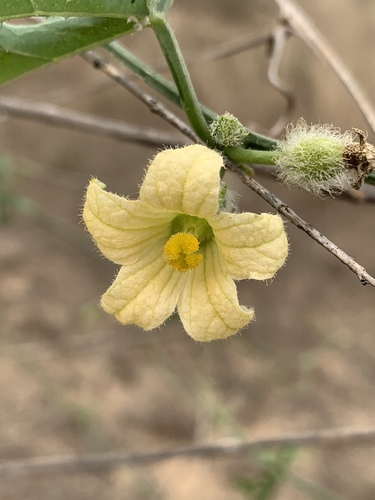
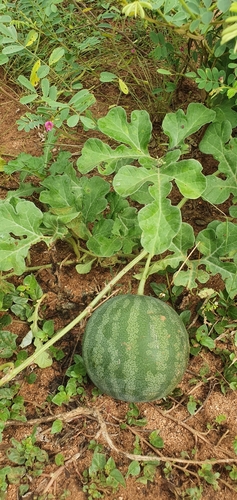
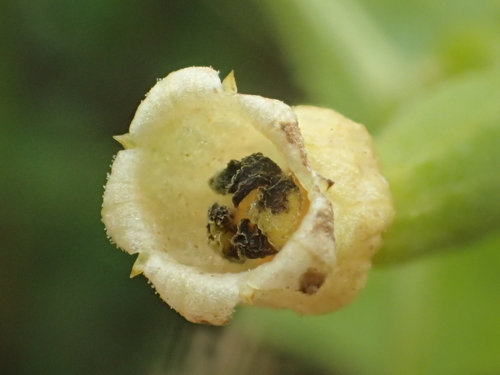
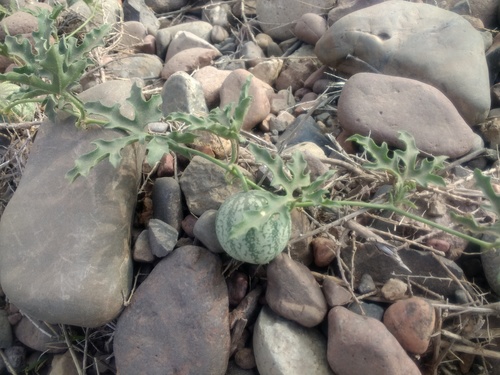
Cucumis dipsaceus Ehrenb. ex Spach is an annual climbing herb in the cucumber family. Its stems can reach several meters in length, grow with a climbing or procumbent trailing habit, and do not develop adventitious roots along their nodes. Stems are quadrangular, weak, and covered in tiny stiff hairs; they are not geniculate, meaning they do not bend sharply at the nodes. Internodes measure 2–6 cm long. Roots do not form tubers, do not harden, and never develop a woody outer layer. Leaves are circular, cordate heart-shaped, trilobed, notched at the base where they attach to the petiole, and covered in hairs on both surfaces. Leaves grow 2–8 cm long and 3–9 cm wide. Petioles range from 2–10 cm long and are also covered in tiny hairs. Dry seeds of this species are caramel brown, elongated and football-shaped, with pointed ends; by comparison, seeds of the cultivated cucumber Cucumis sativus are smooth and pale tan. This species is native to Eastern Africa, where it was first recorded in Sudan, Southern Egypt, and Ethiopia. It is cultivated as a commercial crop in Eastern Africa, and has spread naturally within the region to Kenya, Somalia, parts of Tanzania, and Uganda. It has also been recorded in the Indian states of Karnataka and Tamil Nadu, with observations of growth further south; the method of its spread to India is not documented, though it may have been imported alongside food grains. It has also spread to other Eastern hemisphere mainlands and islands, and is considered an invasive species in Hawaii, parts of the Galapagos Islands, Mexico, Peru, and Ecuador. It grows in tropical and arid habitats, occurring sparsely in areas of dense low vegetation. It is well adapted to disturbed woodlands and agricultural areas prepared by people, and is found at elevations between 400 m and 1,800 m. It is uncommon in foothills, and more common in higher elevation grasslands and woodlands. Cucumis dipsaceus is nutritionally valuable as a food source. It contains a full range of amino acids, including threonine, cysteine, methionine, valine, isoleucine, tyrosine, histidine, phenylalanine, and lysine, with particularly high concentrations of alanine, leucine, and arginine. The fruit's macronutrients are primarily starch (1.07 mg/g) and protein (85.9 mg/g). It also contains a range of minerals including nitrogen, phosphorus, potassium, sodium, magnesium, manganese, calcium, iron, zinc, copper, silicon, and boron, and is a particularly good source of calcium (14820 ppm) and nitrogen (6300 ppm). Traditionally, the plant's young shoots and leaves are cooked with groundnut paste, or with coconut milk when it is available, and the fruit is recommended to be cooked before human consumption; leaves are eaten in native Eastern African growing regions for their nutritional content. Medicinally, the fruit is used as an analgesic. Topical poultices made from the plant's leaves and tendrils are applied to surface wounds to promote healing, and also used to treat soreness and inflammation, though this practice is not widespread. When ingested, the fruit is used to treat gastrointestinal diseases, diarrhea, stomach pain, constipation, and meningitis. Ingested roots of the plant are used to treat hepatitis and gallstones.