About Cucumaria miniata (Brandt, 1835)
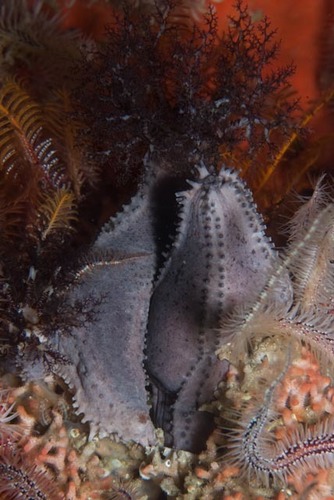
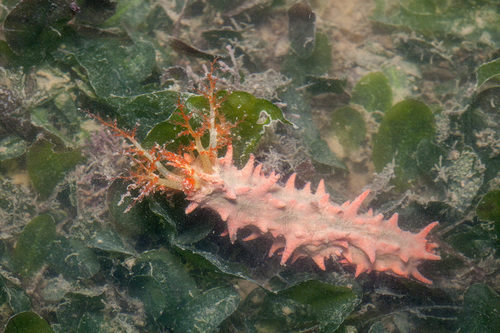
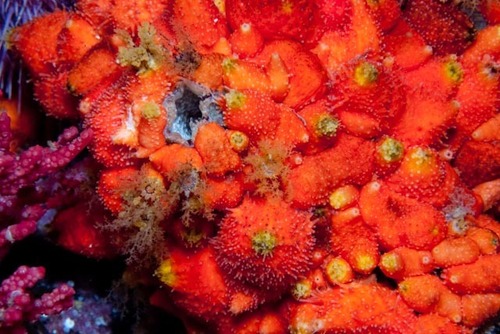
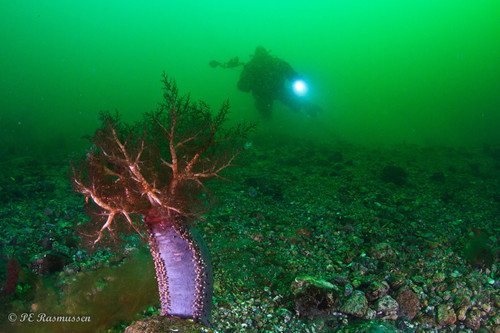
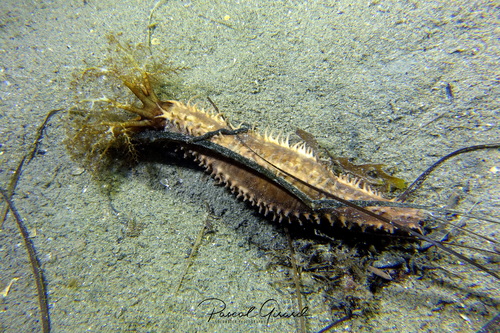
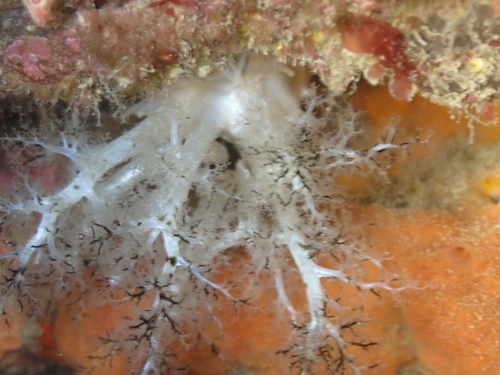
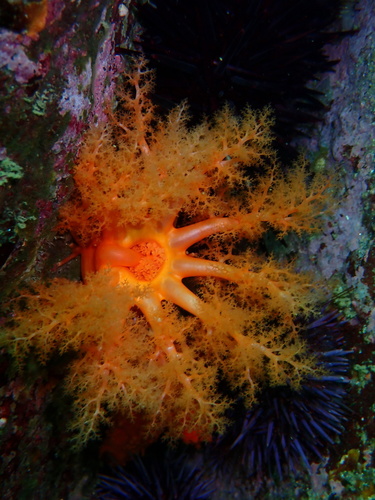
Cucumaria miniata is typically orange or reddish-brown in color. It can be easily identified by its orange coloration and branching tentacles. It has a thick body that bears five rows of tube feet, separated by smooth, soft skin. Pentameric radial symmetry is visible in these five equally spaced rows of tube feet. Like all echinoderms, it has ossicles, which are small and sparsely scattered throughout its dermis. Respiration takes place through respiratory trees, which are two branching tubes located inside the coelom. It has 15 sets of feeding arms that spread out into bushy tentacles when fully extended, and these tentacles lead to a mouth regulated by a sphincter muscle. Its mouth and anus are located at opposite ends of the body, giving it a complete full digestive tract. The lower portion of its body is usually wedged into a crevice, so its tentacles are most often the only visible part of the organism. Cucumaria miniata ranges from northern Alaska to northern Mexico. It inhabits rocky environments from the intertidal zone down to a depth of 100 meters, and is typically found wedged into crevices on docks or between rocks. Because it can attach to a substrate, it commonly occurs in areas with stronger currents to avoid predation.