About Cuculus varius Vahl, 1797
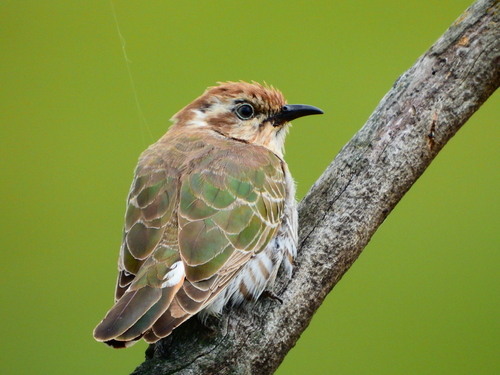
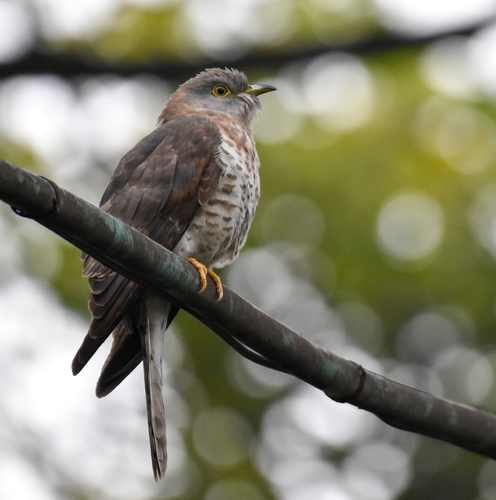
The common hawk-cuckoo, scientific name Cuculus varius Vahl, 1797, is a medium- to large-sized cuckoo roughly the size of a pigeon, at approximately 34 cm in length. Its upper plumage is ashy grey, while its underside is whitish with brown cross-bars. Its tail has broad bars, and the species has a distinctive yellow eye ring. The sexes have similar plumage, though males tend to be larger than females. Subadults have streaked breasts, similar to immature shikra, and large brown chevron marks on their bellies. At first glance, common hawk-cuckoos can be mistaken for hawks. They fly with a flap-and-glide style that resembles the flight of sparrowhawks, especially shikra; when they fly upward and land on a perch, they shake their tails from side to side. This hawk-like appearance and behavior cause many small birds and squirrels to raise alarm calls just as they would when a real hawk is present. This species can be confused with the large hawk-cuckoo, but the large hawk-cuckoo has dark streaks on the throat and breast. Young common hawk-cuckoos have a pale chin, while young large hawk-cuckoos have a black chin. During summer months before the monsoons, males are easy to detect by their repeated calls but hard to spot. The male call is a loud, screaming three-note call, repeated 5 or 6 times, rising in crescendo and ending abruptly. This call can be heard throughout the day and often during moonlit nights. Female common hawk-cuckoos produce a series of grating notes. Common hawk-cuckoos feed mainly on insects, and are specialized feeders that can handle hairy caterpillars. Caterpillar guts often contain toxins, so like many cuckoos, common hawk-cuckoos remove the gut by pressing and rubbing the caterpillar on a branch before swallowing it. The hairs are swallowed with the rest of the caterpillar, separated in the stomach, and regurgitated as a pellet. The common hawk-cuckoo occurs across most of the Indian subcontinent, ranging from Pakistan in the west, across the Himalayan foothills, east to Nepal, Bhutan, Bangladesh and Northeast India, and south into Sri Lanka. Some individuals from the Indian population winter in Sri Lanka. The subspecies ciceliae is resident in the hills of central Sri Lanka. The species is generally resident, but it is locally migratory in high altitudes and arid areas. It is found mostly at lower elevations below 1000m in the Himalayas; at higher elevations, the large hawk-cuckoo tends to be more common. Common hawk-cuckoos are arboreal and rarely descend to the ground. Their habitats include gardens, tree groves, deciduous forests, and semi-evergreen forests. Like many other cuckoos, the common hawk-cuckoo is a brood parasite. It prefers to parasitize babblers of the genus Turdoides, which may be its only host, and has also been reported to parasitize laughing-thrushes of the genus Garrulax. Its breeding season runs from March to June, which coincides with the breeding season of many Turdoides babblers. The common hawk-cuckoo lays a single blue egg in each host nest, matching the color of the host’s eggs. The cuckoo hatchling usually evicts the host’s eggs from the nest and is reared to maturity by its foster parents, following them for nearly a month. T C Jerdon noted that the cuckoo hatchling does not always evict the host’s young, and young cuckoos may be seen alongside young babblers. When moving with a flock of babblers, the cuckoo chick makes a grating kee-kee call to beg for food, and foster parents within the flock will feed it. The main host species in India are Turdoides striatus and Turdoides affinis; common hawk-cuckoos also parasitize the large grey babbler Turdoides malcolmi. In Sri Lanka, the primary host is Turdoides striatus. Parasitic eye-worms of the genus Oxyspirura have been found in the orbital cavity of this species.