About Cuculus saturatus Blyth, 1843
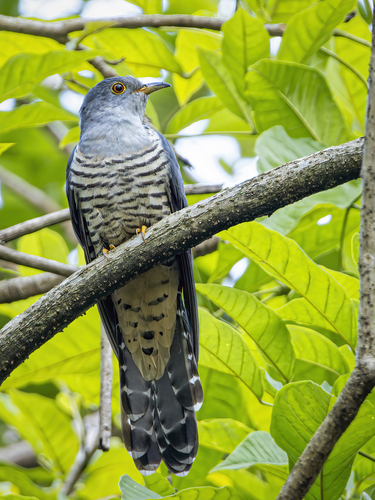
The Himalayan cuckoo (scientific name Cuculus saturatus Blyth, 1843) is a brood parasitic bird in the Cuculidae family. This species breeds from the Himalayas eastward to southern China and Taiwan, and migrates to southeast Asia and the Greater Sunda Islands for the winter. Formerly, this taxon was called "Oriental cuckoo" and included several subspecies found across most of Asia. In 2005, researchers determined this grouped "species" actually consists of three distinct lineages: the Himalayan cuckoo (Cuculus (saturatus) saturatus), the Oriental cuckoo proper (Cuculus (saturatus) optatus), and the Sunda cuckoo (Cuculus (saturatus) lepidus). These three lineages are now usually treated as separate species. Because the type specimen of the former broad "Oriental cuckoo" belongs to the Himalayan population, the name saturatus applies to the Himalayan cuckoo when it is recognized as a full species. During warm breeding months, the Himalayan cuckoo is found across northeast Pakistan, from the northern Indian subcontinent to southern China, and has been spotted in Kashmir, Assam, Nepal, Burma, Thailand, and Taiwan. Its breeding range spans the Oriental Region, from the Himalayas through southeast Asia to east China and Taiwan, and it is rarely found above 1000m elevation in this season. Breeding activity occurs from late April to August in the Kashmir region, and from March to September in areas surrounding Nepal. In the non-breeding winter season, which falls between October and May, it ranges from southeast Asia to northern Australia, including Malaysia, the Philippines, Indonesia, New Guinea, the Greater Sundas, and the Philippines. Cuculus optatus, the separate species now split from the former broad Oriental cuckoo, looks almost identical to C. saturatus, and their winter ranges overlap across most of the same regions. This overlap and similarity is an additional reason the two species are often misidentified. During the spring and summer breeding season, the Himalayan cuckoo typically inhabits mixed coniferous and deciduous forests, thickets, birch stands, mountain forests, steppes with bushes, other wooded areas, and orchards. In Kashmir, Myanmar, and Nepal, it usually occurs between 1500m and 3300m above the tree line; in southwest China it has been recorded as high as 4500m. During the colder non-breeding season, it lives in primary and secondary tropical forests, savannas, gardens, teak plantations, and monsoon rainforests. More recently, it has been found more occasionally in swamps, mangroves, and plantations of Australia, as well as low elevation habitats between 1200m and 2000m on the Malay Peninsula, Sumatra, and Borneo.